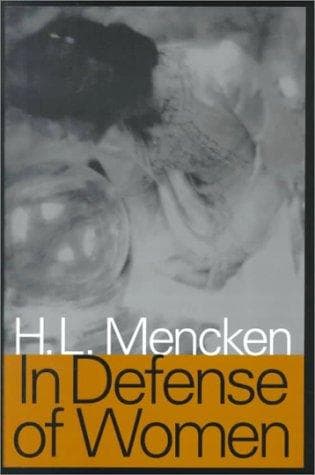
Sexism; Women -- Social and moral questions; Women -- Social conditions
Men, as every one knows, are disposed to question this superior
intelligence of women; their egoism demands the denial, and they are
seldom reflective enough to dispose of it by logical and evidential
analysis. Moreover, as we shall see a bit later on, there is a certain
specious appearance of soundness in their position; they have forced
upon women an artificial character which well conceals their real
character, and women have found it profitable to encourage the
deception. But though every normal man thus cherishes the soothing
unction that he is the intellectual superior of all women, and
particularly of his wife, he constantly gives the lie to his pretension
by consulting and deferring to what he calls her intuition. That is to
say, he knows by experience that her judgment in many matters of
capital concern is more subtle and searching than his own, and, being
disinclined to accredit this greater sagacity to a more competent
intelligence, he takes refuge behind the doctrine that it is due to
some impenetrable and intangible talent for guessing correctly, some
half mystical super sense, some vague (and, in essence, infra-human)
instinct.
The true nature of this alleged instinct, however, is revealed by an
examination of the situations which inspire a man to call it to his
aid. These situations do not arise out of the purely technical problems
that are his daily concern, but out of the rarer and more fundamental,
and hence enormously more difficult problems which beset him only at
long and irregular intervals, and so offer a test, not of his mere
capacity for being drilled, but of his capacity for genuine
ratiocination. No man, I take it, save one consciously inferior and
hen-pecked, would consult his wife about hiring a clerk, or about
extending credit to some paltry customer, or about some routine piece
of tawdry swindling; but not even the most egoistic man would fail to
sound the sentiment of his wife about taking a partner into his
business, or about standing for public office, or about combating
unfair and ruinous competition, or about marrying off their daughter.
Such things are of massive importance; they lie at the foundation of
well-being; they call for the best thought that the man confronted by
them can muster; the perils hidden in a wrong decision overcome even
the clamors of vanity. It is in such situations that the superior
mental grasp of women is of obvious utility, and has to be admitted. It
is here that they rise above the insignificant sentimentalities,
superstitions and formulae of men, and apply to the business their
singular talent for separating the appearance from the substance, and
so exercise what is called their intuition.
Public-domain text, read in full here on John Shaqi.
Reviews
Reviews
No reviews yet
Be the first to share your thoughts on this work.
Join the Discussion
Join the discussion
Sign in to leave a comment or review.
Sign InorCreate an account