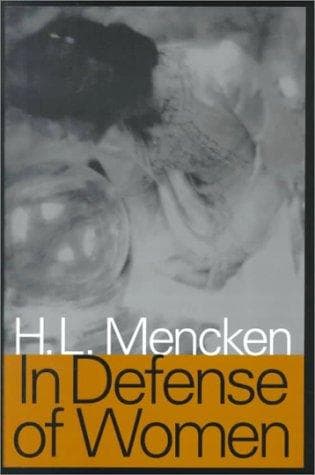
Sexism; Women -- Social and moral questions; Women -- Social conditions
But here I rather depart from the point, which is this: that the
average woman is not strategically capable of bringing down the most
tempting game within her purview, and must thus content herself with a
second, third, or nth choice. The only women who get their first
choices are those who run in almost miraculous luck and those too
stupid to formulate an ideal—two very small classes, it must be
obvious. A few women, true enough, are so pertinacious that they prefer
defeat to compromise. That is to say, they prefer to put off marriage
indefinitely rather than to marry beneath the highest leap of their
fancy. But such women may be quickly dismissed as abnormal, and perhaps
as downright diseased in mind; the average woman is well-aware that
marriage is far better for her than celibacy, even when it falls a good
deal short of her primary hopes, and she is also well aware that the
differences between man and man, once mere money is put aside, are so
slight as to be practically almost negligible. Thus the average woman
is under none of the common masculine illusions about elective
affinities, soul mates, love at first sight, and such phantasms. She is
quite ready to fall in love, as the phrase is, with any man who is
plainly eligible, and she usually knows a good many more such men than
one. Her primary demand in marriage is not for the agonies of romance,
but for comfort and security; she is thus easier satisfied than a man,
and oftener happy. One frequently hears of remarried widowers who
continue to moon about their dead first wives, but for a remarried
widow to show any such sentimentality would be a nine days’ wonder.
Once replaced, a dead husband is expunged from the minutes. And so is a
dead love.
One of the results of all this is a subtle reinforcement of the
contempt with which women normally regard their husbands—a contempt
grounded, as I have shown, upon a sense of intellectual superiority. To
this primary sense of superiority is now added the disparagement of a
concrete comparison, and over all is an ineradicable resentment of the
fact that such a comparison has been necessary. In other words, the
typical husband is a second-rater, and no one is better aware of it
than his wife. He is, taking averages, one who has been loved, as the
saying goes, by but one woman, and then only as a second, third or nth
choice. If any other woman had ever loved him, as the idiom has it, she
would have married him, and so made him ineligible for his present
happiness. But the average bachelor is a man who has been loved, so to
speak, by many women, and is the lost first choice of at least some of
them. Here presents the unattainable, and hence the admirable; the
husband is the attained and disdained.
Public-domain text, read in full here on John Shaqi.
Reviews
Reviews
No reviews yet
Be the first to share your thoughts on this work.
Join the Discussion
Join the discussion
Sign in to leave a comment or review.
Sign InorCreate an account