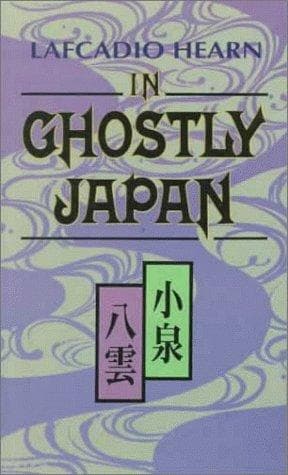
Buddhism; Folklore -- Japan; Japan -- Social life and customs
Tomozō wondered as he listened,—because the language of the woman was
not the language of a common woman, but the language of a lady of
rank.[9] Then he determined at all hazards to get one glimpse of her
face; and he crept round the house, backwards and forwards, peering
through every crack and chink. And at last he was able to see;—but
therewith an icy trembling seized him; and the hair of his head stood
up.
[9] The forms of speech used by the samurai, and other superior
classes, differed considerably from those of the popular idiom; but
these differences could not be effectively rendered into English.
For the face was the face of a woman long dead,—and the fingers
caressing were fingers of naked bone,—and of the body below the waist
there was not anything: it melted off into thinnest trailing shadow.
Where the eyes of the lover deluded saw youth and grace and beauty,
there appeared to the eyes of the watcher horror only, and the
emptiness of death. Simultaneously another woman’s figure, and a
weirder, rose up from within the chamber, and swiftly made toward the
watcher, as if discerning his presence. Then, in uttermost terror, he
fled to the dwelling of Hakuōdō Yusai, and, knocking frantically at the
doors, succeeded in arousing him.
V
Hakuōdō Yusai, the _ninsomi_, was a very old man; but in his time he
had travelled much, and he had heard and seen so many things that he
could not be easily surprised. Yet the story of the terrified Tomozō
both alarmed and amazed him. He had read in ancient Chinese books of
love between the living and the dead; but he had never believed it
possible. Now, however, he felt convinced that the statement of Tomozō
was not a falsehood, and that something very strange was really going
on in the house of Hagiwara. Should the truth prove to be what Tomozō
imagined, then the young samurai was a doomed man.
“If the woman be a ghost,”—said Yusai to the frightened servant, “—if
the woman be a ghost, your master must die very soon,—unless something
extraordinary can be done to save him. And if the woman be a ghost, the
signs of death will appear upon his face. For the spirit of the living
is _yōki_, and pure;—the spirit of the dead is _inki_, and unclean: the
one is Positive, the other Negative. He whose bride is a ghost cannot
live. Even though in his blood there existed the force of a life of one
hundred years, that force must quickly perish…. Still, I shall do all
that I can to save Hagiwara Sama. And in the meantime, Tomozō, say
nothing to any other person,—not even to your wife,—about this matter.
At sunrise I shall call upon your master.”
VI
Public-domain text, read in full here on John Shaqi.
Reviews
Reviews
No reviews yet
Be the first to share your thoughts on this work.
Join the Discussion
Join the discussion
Sign in to leave a comment or review.
Sign InorCreate an account