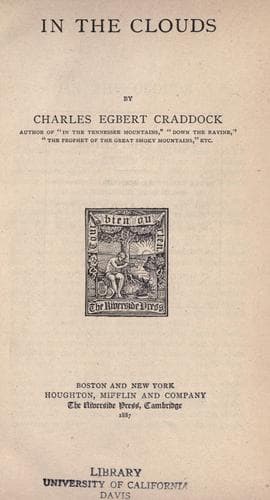
Mountain life -- Tennessee -- Fiction; United States -- Social life and customs -- 19th century -- Fiction
As Kenbigh went on, expounding the relative and interdependent functions
of the brain and eye, the fine and subtle theories of spiritual and
physical life, its vague boundaries, its unmeasured capabilities,—the
deductions, the keen analysis of science, all reduced to the vernacular
in the mouth of a man trained by years of practice to speak to the
people,—Harshaw sat in blank dismay. He had never heard of any spiritual
manifestation but the vulgar graveyard ghost, usually headless, stalking
in its shroud to accomplish missions of vengeance upon the very ignorant
in the deep midnight. But Kenbigh’s account of sundry ethereal-minded
and mild-mannered spectres, with a preference for high company, singing,
appearing at dinner-tables, conversing agreeably, arrayed in conventional
garb, as decorous and reasonable and as mindful of etiquette as if
still bound by all the restraints of the world, the flesh, and the
devil, disappearing as noiselessly as they had come, with no appreciable
result of the visit,—it shocked every sense of precedent within him.
He was country-bred and did not know that when ghosts are fashionable
they conduct themselves as fashionable people do. He noted keenly the
discrepancies in the scientific explanations. Always, despite its show of
learning, its systems, its terminology, its physiology, its psychology,
and its persistent reference of supernatural appearances to natural
causes, Reason retires from the spectral exhibition with some admission
of occult influences, not fully understood,—in effect making a bow to the
ghost in question, “Saving your presence.” He noticed, too, that the jury
were listening with that intentness and eager interest which characterize
every mind, even the most ignorant, in considering things of the other
world, manifestations of hidden agencies. When he rose to reply he felt
at a loss. The sound, however, of his own hearty voice ringing against
the walls, instead of the sepulchral basso profundo of the attorney for
the State, the motion of his own stalwart arm sawing the air,—for he
was in the habit of impressing his views with a good deal of muscular
exertion,—had an invigorating effect upon him, and brought him back to
his normal state of confidence and bluster. He found words for his ready
scorn. He sought to discredit the attorney-general’s phantoms. He did not
know where the counsel got these old women’s tales; they were an insult
to the intelligence of the jury. The learned counsel knew mighty well
he wasn’t going to be called upon for his authorities,—medical books
can’t be produced as evidence in a court of justice, much less ghost
stories, “Raw-head and bloody-bones”! For his own part, he didn’t believe
a word of them. A fact is a thing that can be proved. The law requires
authentication. “Henry Brougham, Lord Chancellor, saw visions, did he?
And may be Lord Coke dreamed dreams,” he sneered indignantly. “And Lord
Mansfield perchance walked in his sleep. And who knows they did? And what
Public-domain text, read in full here on John Shaqi.
Reviews
Reviews
No reviews yet
Be the first to share your thoughts on this work.
Elsewhere in the archive
Join the Discussion
Join the discussion
Sign in to leave a comment or review.
Sign InorCreate an account