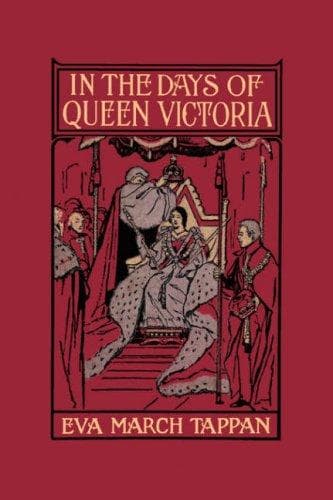
Great Britain -- History -- Victoria, 1837-1901 -- Fiction
"There are more Whigs than Tories in the House of Commons," said Peel,
"and if these ladies who are closely related to prominent Whigs are
retained, all Europe will look upon England as the country that is
governed by a party which the sovereign dislikes and in which she has
no confidence."
"I give you my lords," replied the Queen steadfastly, "but I keep my
ladies." The two nobles were in a dilemma. According to the British
constitution, "The Queen can do no wrong"--that is, not she, but the
Prime Minister is held responsible for every public act. Sir Robert
could not remain Prime Minister if the Queen positively refused to
yield to a course which he thought necessary.
While the Tory leaders were trying to plan some way out of the
difficulty, the Queen sent a letter to Lord Melbourne which was written
in much the same way that an indignant young girl would write to her
father. "Do not fear," she said, "that I was not calm and composed.
They wanted to deprive me of my ladies, and I suppose they would
deprive me next of my dressers and housemaids; they wished to treat me
like a girl, but I will show them that I am Queen of England."
Lord Melbourne called his Cabinet together in such haste that one
member had to be brought from the opera and another from a dinner
party. He read them the Queen's letter, and asked, "What shall we
advise?"
"Advise her to give up two or three of her principal ladies," suggested
one, "and perhaps that will satisfy Peel."
"Does anyone know exactly what Peel wants," queried another, "and how
many ladies he demands shall be removed?" This was an exceedingly
sensible question, and if it had been taken to Peel for an answer, the
trouble might have been brought to an end. He would probably have been
satisfied with the resignation of two or three of the strongest
partisans and principal talkers among the ladies; and, although the
Queen was insisting upon what she believed was her right, yet much of
her indignation arose from her belief that Peel meant to deprive her of
all who were then her attendants perhaps even the Baroness Lehzen. The
question was not taken to Peel, however, and the discussion in the
Cabinet went on.
"Let us write a letter for the Queen to copy and send to Peel," was the
next suggestion, "saying that she will not consent to a course which
she believes to be contrary to custom and which is repugnant to her
feelings." This suggestion was adopted. The letter was written, and the
Queen copied it to send; but before it reached Sir Robert, he resigned
his position, and Lord Melbourne was again Prime Minister.
This was the famous "Bedchamber Plot," and it aroused all England. Lord
Melbourne and the Whigs said:
"It is a small matter that the Queen should be allowed to retain her
favorite attendants."
Sir Robert and the Tories replied:
Public-domain text, read in full here on John Shaqi.
Reviews
Reviews
No reviews yet
Be the first to share your thoughts on this work.
Elsewhere in the archive
Join the Discussion
Join the discussion
Sign in to leave a comment or review.
Sign InorCreate an account