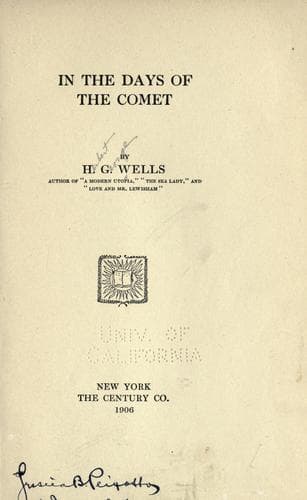
In the Days of the CometWells, H. G. (Herbert George)
Science
In the Days of the Comet
Wells, H. G. (Herbert George)
Comets -- Collisions with Earth -- Fiction; Political fiction; Science fiction; Utopian fiction; Utopias -- Fiction
My mind ran for a time on Swindells, on the imbecile pushfulness of
that extinct creature, dealing in rubbish, covering the country-side
with lies in order to get—what had he sought?—a silly, ugly, great
house, a temper-destroying motor-car, a number of disrespectful, abject
servants; thwarted intrigues for a party-fund baronetcy as the crest of
his life, perhaps. You cannot imagine the littleness of those former
times; their naive, queer absurdities! And for the first time in my
existence I thought of these things without bitterness. In the former
days I had seen wickedness, I had seen tragedy, but now I saw only the
extraordinary foolishness of the old life. The ludicrous side of human
wealth and importance turned itself upon me, a shining novelty, poured
down upon me like the sunrise, and engulfed me in laughter. Swindells!
Swindells, damned! My vision of Judgment became a delightful burlesque.
I saw the chuckling Angel sayer with his face veiled, and the corporeal
presence of Swindells upheld amidst the laughter of the spheres.
“Here’s a thing, and a very pretty thing, and what’s to be done with
this very pretty thing?” I saw a soul being drawn from a rotund,
substantial-looking body like a whelk from its shell. . . .
I laughed loudly and long. And behold! even as I laughed the keen point
of things accomplished stabbed my mirth, and I was weeping, weeping
aloud, convulsed with weeping, and the tears were pouring down my face.
§ 3
Everywhere the awakening came with the sunrise. We awakened to the
gladness of the morning; we walked dazzled in a light that was joy.
Everywhere that was so. It was always morning. It was morning because,
until the direct rays of the sun touched it, the changing nitrogen of
our atmosphere did not pass into its permanent phase, and the sleepers
lay as they had fallen. In its intermediate state the air hung inert,
incapable of producing either revival or stupefaction, no longer green,
but not yet changed to the gas that now lives in us. . . .
To every one, I think, came some parallel to the mental states I have
already sought to describe—a wonder, an impression of joyful novelty.
There was also very commonly a certain confusion of the intelligence, a
difficulty in self-recognition. I remember clearly as I sat on my stile
that presently I had the clearest doubts of my own identity and fell
into the oddest metaphysical questionings. “If this be I,” I said,
“then how is it I am no longer madly seeking Nettie? Nettie is now the
remotest thing—and all my wrongs. Why have I suddenly passed out of all
that passion? Why does not the thought of Verrall quicken my pulses?” .
. .
Public-domain text, read in full here on John Shaqi.
Reviews
Reviews
No reviews yet
Be the first to share your thoughts on this work.
Elsewhere in the archive
Join the Discussion
Join the discussion
Sign in to leave a comment or review.
Sign InorCreate an account