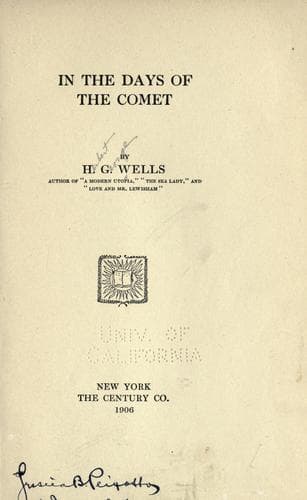
In the Days of the CometWells, H. G. (Herbert George)
Science
In the Days of the Comet
Wells, H. G. (Herbert George)
Comets -- Collisions with Earth -- Fiction; Political fiction; Science fiction; Utopian fiction; Utopias -- Fiction
I was only one of many millions who that morning had the same doubts. I
suppose one knows one’s self for one’s self when one returns from sleep
or insensibility by the familiarity of one’s bodily sensations, and
that morning all our most intimate bodily sensations were changed. The
intimate chemical processes of life were changed, its nervous metaboly.
For the fluctuating, uncertain, passion-darkened thought and feeling of
the old time came steady, full-bodied, wholesome processes. Touch was
different, sight was different, sound and all the senses were subtler;
had it not been that our thought was steadier and fuller, I believe
great multitudes of men would have gone mad. But, as it was, we
understood. The dominant impression I would convey in this account of
the Change is one of enormous release, of a vast substantial
exaltation. There was an effect, as it were, of light-headedness that
was also clear-headedness, and the alteration in one’s bodily
sensations, instead of producing the mental obfuscation, the loss of
identity that was a common mental trouble under former conditions, gave
simply a new detachment from the tumid passions and entanglements of
the personal life.
In this story of my bitter, restricted youth that I have been telling
you, I have sought constantly to convey the narrowness, the intensity,
the confusion, muddle, and dusty heat of the old world. It was quite
clear to me, within an hour of my awakening, that all that was, in some
mysterious way, over and done. That, too, was the common experience.
Men stood up; they took the new air into their lungs—a deep long
breath, and the past fell from them; they could forgive, they could
disregard, they could attempt. . . . And it was no new thing, no
miracle that sets aside the former order of the world. It was a change
in material conditions, a change in the atmosphere, that at one bound
had released them. Some of them it had released to death. . . . Indeed,
man himself had changed not at all. We knew before the Change, the
meanest knew, by glowing moments in ourselves and others, by histories
and music and beautiful things, by heroic instances and splendid
stories, how fine mankind could be, how fine almost any human being
could upon occasion be; but the poison in the air, its poverty in all
the nobler elements which made such moments rare and remarkable—all
that has changed. The air was changed, and the Spirit of Man that had
drowsed and slumbered and dreamt dull and evil things, awakened, and
stood with wonder-clean eyes, refreshed, looking again on life.
§ 4
Public-domain text, read in full here on John Shaqi.
Reviews
Reviews
No reviews yet
Be the first to share your thoughts on this work.
Elsewhere in the archive
Join the Discussion
Join the discussion
Sign in to leave a comment or review.
Sign InorCreate an account