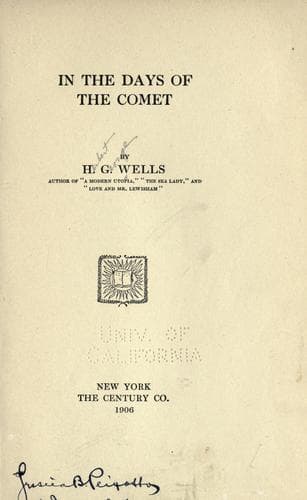
In the Days of the CometWells, H. G. (Herbert George)
Science
In the Days of the Comet
Wells, H. G. (Herbert George)
Comets -- Collisions with Earth -- Fiction; Political fiction; Science fiction; Utopian fiction; Utopias -- Fiction
I thought he was going to add something more about that, but there
lingered a habit of reticence in the man that held him for the moment.
“It is a very curious thing,” he broke away; “that this pain should be,
on the whole, more interesting than disagreeable.”
“You are in pain?”
“My ankle is! It’s either broken or badly sprained—I think sprained;
it’s very painful to move, but personally I’m not in pain. That sort of
general sickness that comes with local injury—not a trace of it! . . .”
He mused and remarked, “I was speaking at Colchester, and saying things
about the war. I begin to see it better. The reporters—scribble,
scribble. Max Sutaine, 1885. Hubbub. Compliments about the oysters.
Mm—mm. . . . What was it? About the war? A war that must needs be long
and bloody, taking toll from castle and cottage, taking toll! . . .
Rhetorical gusto! Was I drunk last night?”
His eyebrows puckered. He had drawn up his right knee, his elbow rested
thereon and his chin on his fist. The deep-set gray eyes beneath his
thatch of eyebrow stared at unknown things. “My God!” he murmured, “My
God!” with a note of disgust. He made a big brooding figure in the
sunlight, he had an effect of more than physical largeness; he made me
feel that it became me to wait upon his thinking. I had never met a man
of this sort before; I did not know such men existed. . . .
It is a curious thing, that I cannot now recall any ideas whatever that
I had before the Change about the personalities of statesmen, but I
doubt if ever in those days I thought of them at all as tangible
individual human beings, conceivably of some intellectual complexity. I
believe that my impression was a straightforward blend of caricature
and newspaper leader. I certainly had no respect for them. And now
without servility or any insincerity whatever, as if it were a
first-fruit of the Change, I found myself in the presence of a human
being towards whom I perceived myself inferior and subordinate, before
whom I stood without servility or any insincerity whatever, in an
attitude of respect and attention. My inflamed, my rancid egotism—or
was it after all only the chances of life?—had never once permitted
that before the Change.
He emerged from his thoughts, still with a faint perplexity in his
manner. “That speech I made last night,” he said, “was damned
mischievous nonsense, you know. Nothing can alter that. Nothing. . . .
No! . . . Little fat gnomes in evening dress—gobbling oysters. Gulp!”
It was a most natural part of the wonder of that morning that he should
adopt this incredible note of frankness, and that it should abate
nothing from my respect for him.
“Yes,” he said, “you are right. It’s all indisputable fact, and I can’t
believe it was anything but a dream.”
§ 5
Public-domain text, read in full here on John Shaqi.
Reviews
Reviews
No reviews yet
Be the first to share your thoughts on this work.
Elsewhere in the archive
Join the Discussion
Join the discussion
Sign in to leave a comment or review.
Sign InorCreate an account