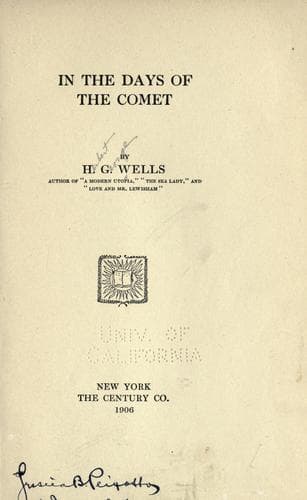
In the Days of the CometWells, H. G. (Herbert George)
Science
In the Days of the Comet
Wells, H. G. (Herbert George)
Comets -- Collisions with Earth -- Fiction; Political fiction; Science fiction; Utopian fiction; Utopias -- Fiction
That memory stands out against the dark past of the world with
extraordinary clearness and brightness. The air, I remember, was full
of the calling and piping and singing of birds. I have a curious
persuasion too that there was a distant happy clamor of pealing bells,
but that I am half convinced is a mistake. Nevertheless, there was
something in the fresh bite of things, in the dewy newness of sensation
that set bells rejoicing in one’s brain. And that big, fair, pensive
man sitting on the ground had beauty even in his clumsy pose, as though
indeed some Great Master of strength and humor had made him.
And—it is so hard now to convey these things—he spoke to me, a
stranger, without reservations, carelessly, as men now speak to men.
Before those days, not only did we think badly, but what we thought, a
thousand short-sighted considerations, dignity, objective discipline,
discretion, a hundred kindred aspects of shabbiness of soul, made us
muffle before we told it to our fellow-men.
“It’s all returning now,” he said, and told me half soliloquizingly
what was in his mind.
I wish I could give every word he said to me; he struck out image after
image to my nascent intelligence, with swift broken fragments of
speech. If I had a precise full memory of that morning I should give it
you, verbatim, minutely. But here, save for the little sharp things
that stand out, I find only blurred general impressions. Throughout I
have to make up again his half-forgotten sentences and speeches, and be
content with giving you the general effect. But I can see and hear him
now as he said, “The dream got worst at the end. The war—a perfectly
horrible business! Horrible! And it was just like a nightmare, you
couldn’t do anything to escape from it—every one was driven!”
His sense of indiscretion was gone.
He opened the war out to me—as every one sees it now. Only that morning
it was astonishing. He sat there on the ground, absurdly forgetful of
his bare and swollen foot, treating me as the humblest accessory and as
altogether an equal, talking out to himself the great obsessions of his
mind. “We could have prevented it! Any of us who chose to speak out
could have prevented it. A little decent frankness. What was there to
prevent us being frank with one another? Their emperor—his position was
a pile of ridiculous assumptions, no doubt, but at bottom—he was a sane
man.” He touched off the emperor in a few pithy words, the German
press, the German people, and our own. He put it as we should put it
all now, but with a certain heat as of a man half guilty and wholly
resentful. “Their damned little buttoned-up professors!” he cried,
incidentally. “Were there ever such men? And ours! Some of us might
have taken a firmer line. . . . If a lot of us had taken a firmer line
and squashed that nonsense early. . . .”
He lapsed into inaudible whisperings, into silence. . . .
Public-domain text, read in full here on John Shaqi.
Reviews
Reviews
No reviews yet
Be the first to share your thoughts on this work.
Elsewhere in the archive
Join the Discussion
Join the discussion
Sign in to leave a comment or review.
Sign InorCreate an account