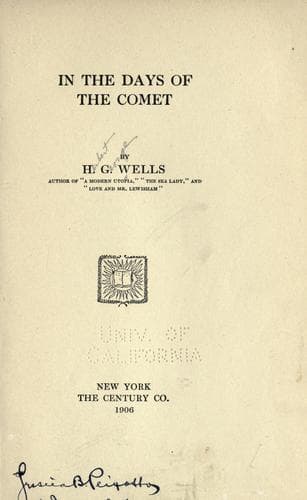
In the Days of the CometWells, H. G. (Herbert George)
Science
In the Days of the Comet
Wells, H. G. (Herbert George)
Comets -- Collisions with Earth -- Fiction; Political fiction; Science fiction; Utopian fiction; Utopias -- Fiction
Those old-time revivals were, I say, the convulsive movements of a body
that suffocates. They are the clearest manifestations from before the
Change of a sense in all men that things were not right. But they were
too often but momentary illuminations. Their force spent itself in
inco-ordinated shouting, gesticulations, tears. They were but flashes
of outlook. Disgust of the narrow life, of all baseness, took shape in
narrowness and baseness. The quickened soul ended the night a
hypocrite; prophets disputed for precedence; seductions, it is
altogether indisputable, were frequent among penitents! and Ananias
went home converted and returned with a falsified gift. And it was
almost universal that the converted should be impatient and immoderate,
scornful of reason and a choice of expedients, opposed to balance,
skill, and knowledge. Incontinently full of grace, like thin old
wine-skins overfilled, they felt they must burst if once they came into
contact with hard fact and sane direction.
So the former revivals spent themselves, but the Great Revival did not
spend itself, but grew to be, for the majority of Christendom at least,
the permanent expression of the Change. For many it has taken the shape
of an outright declaration that this was the Second Advent—it is not
for me to discuss the validity of that suggestion, for nearly all it
has amounted to an enduring broadening of all the issues of life. . . .
§ 8
One irrelevant memory comes back to me, irrelevant, and yet by some
subtle trick of quality it summarizes the Change for me. It is the
memory of a woman’s very beautiful face, a woman with a flushed face
and tear-bright eyes who went by me without speaking, rapt in some
secret purpose. I passed her when in the afternoon of the first day,
struck by a sudden remorse, I went down to Menton to send a telegram to
my mother telling her all was well with me. Whither this woman went I
do not know, nor whence she came; I never saw her again, and only her
face, glowing with that new and luminous resolve, stands out for me. .
. .
But that expression was the world’s.
CHAPTER THE THIRD
THE CABINET COUNCIL
§ 1
Public-domain text, read in full here on John Shaqi.
Reviews
Reviews
No reviews yet
Be the first to share your thoughts on this work.
Elsewhere in the archive
Join the Discussion
Join the discussion
Sign in to leave a comment or review.
Sign InorCreate an account