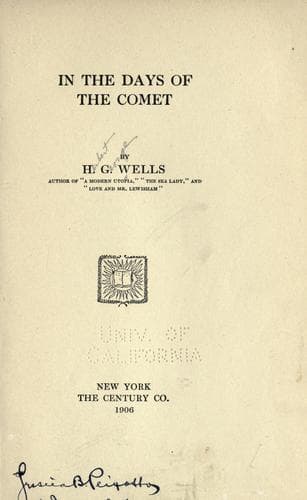
In the Days of the CometWells, H. G. (Herbert George)
Science
In the Days of the Comet
Wells, H. G. (Herbert George)
Comets -- Collisions with Earth -- Fiction; Political fiction; Science fiction; Utopian fiction; Utopias -- Fiction
I saw these men quickened indeed by the Change, but still wearing the
queer clothing of the old time, the manners and conventions of the old
time; if they had disengaged themselves from the outlook of the old
time they still had to refer back to it constantly as a common
starting-point. My refreshed intelligence was equal to that, so that I
think I did indeed see them. There was Gorrell-Browning, the Chancellor
of the Duchy; I remember him as a big round-faced man, the essential
vanity and foolishness of whose expression, whose habit of voluminous
platitudinous speech, triumphed absurdly once or twice over the roused
spirit within. He struggled with it, he burlesqued himself, and
laughed. Suddenly he said simply, intensely—it was a moment for every
one of clean, clear pain, “I have been a vain and self-indulgent and
presumptuous old man. I am of little use here. I have given myself to
politics and intrigues, and life is gone from me.” Then for a long time
he sat still. There was Carton, the Lord Chancellor, a white-faced man
with understanding, he had a heavy, shaven face that might have stood
among the busts of the Caesars, a slow, elaborating voice, with
self-indulgent, slightly oblique, and triumphant lips, and a momentary,
voluntary, humorous twinkle. “We have to forgive,” he said. “We have to
forgive—even ourselves.”
These two were at the top corner of the table, so that I saw their
faces well. Madgett, the Home Secretary, a smaller man with wrinkled
eyebrows and a frozen smile on his thin wry mouth, came next to Carton;
he contributed little to the discussion save intelligent comments, and
when the electric lights above glowed out, the shadows deepened queerly
in his eye-sockets and gave him the quizzical expression of an ironical
goblin. Next him was that great peer, the Earl of Richover, whose
self-indulgent indolence had accepted the _rôle_ of a twentieth-century
British Roman patrician of culture, who had divided his time almost
equally between his jockeys, politics, and the composition of literary
studies in the key of his _rôle_. “We have done nothing worth doing,”
he said. “As for me, I have cut a figure!” He reflected—no doubt on his
ample patrician years, on the fine great houses that had been his
setting, the teeming race-courses that had roared his name, the
enthusiastic meetings he had fed with fine hopes, the futile Olympian
beginnings. . . . “I have been a fool,” he said compactly. They heard
him in a sympathetic and respectful silence.
Public-domain text, read in full here on John Shaqi.
Reviews
Reviews
No reviews yet
Be the first to share your thoughts on this work.
Elsewhere in the archive
Join the Discussion
Join the discussion
Sign in to leave a comment or review.
Sign InorCreate an account