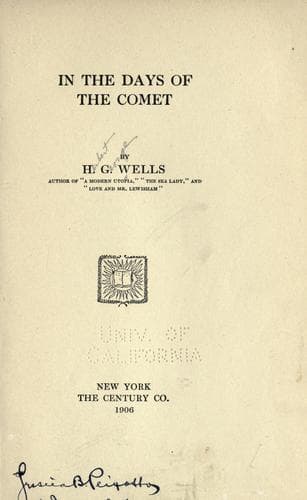
In the Days of the CometWells, H. G. (Herbert George)
Science
In the Days of the Comet
Wells, H. G. (Herbert George)
Comets -- Collisions with Earth -- Fiction; Political fiction; Science fiction; Utopian fiction; Utopias -- Fiction
Gurker, the Chancellor of the Exchequer, was partially occulted, so far
as I was concerned, by the back of Lord Adisham. Ever and again Gurker
protruded into the discussion, swaying forward, a deep throaty voice, a
big nose, a coarse mouth with a drooping everted lower lip, eyes
peering amidst folds and wrinkles. He made his confession for his race.
“We Jews,” he said, “have gone through the system of this world,
creating nothing, consolidating many things, destroying much. Our
racial self-conceit has been monstrous. We seem to have used our ample
coarse intellectuality for no other purpose than to develop and master
and maintain the convention of property, to turn life into a sort of
mercantile chess and spend our winnings grossly. . . . We have had no
sense of service to mankind. Beauty which is godhead—we made it a
possession.”
These men and these sayings particularly remain in my memory. Perhaps,
indeed, I wrote them down at the time, but that I do not now remember.
How Sir Digby Privet, Revel, Markheimer, and the others sat I do not
now recall; they came in as voices, interruptions, imperfectly assigned
comments. . . .
One got a queer impression that except perhaps for Gurker or Revel
these men had not particularly wanted the power they held; had desired
to do nothing very much in the positions they had secured. They had
found themselves in the cabinet, and until this moment of illumination
they had not been ashamed; but they had made no ungentlemanly fuss
about the matter. Eight of that fifteen came from the same school, had
gone through an entirely parallel education; some Greek linguistics,
some elementary mathematics, some emasculated “science,” a little
history, a little reading in the silent or timidly orthodox English
literature of the seventeenth, eighteenth, and nineteenth centuries,
all eight had imbibed the same dull gentlemanly tradition of behavior;
essentially boyish, unimaginative—with neither keen swords nor art in
it, a tradition apt to slobber into sentiment at a crisis and make a
great virtue of a simple duty rather clumsily done. None of these eight
had made any real experiments with life, they had lived in blinkers,
they had been passed from nurse to governess, from governess to
preparatory school, from Eton to Oxford, from Oxford to the
politico-social routine. Even their vices and lapses had been according
to certain conceptions of good form. They had all gone to the races
surreptitiously from Eton, had all cut up to town from Oxford to see
life—music-hall life—had all come to heel again. Now suddenly they
discovered their limitations. . . .
Public-domain text, read in full here on John Shaqi.
Reviews
Reviews
No reviews yet
Be the first to share your thoughts on this work.
Elsewhere in the archive
Join the Discussion
Join the discussion
Sign in to leave a comment or review.
Sign InorCreate an account