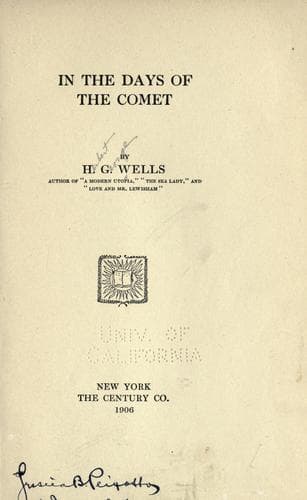
In the Days of the CometWells, H. G. (Herbert George)
Science
In the Days of the Comet
Wells, H. G. (Herbert George)
Comets -- Collisions with Earth -- Fiction; Political fiction; Science fiction; Utopian fiction; Utopias -- Fiction
He leans over the table toward me with an evident desire to make
himself perfectly understood. “I find myself like some creature that is
taken out of its shell—soft and new. I was trained to dress in a
certain way, to behave in a certain way, to think in a certain way; I
see now it’s all wrong and narrow—most of it anyhow—a system of class
shibboleths. We were decent to each other in order to be a gang to the
rest of the world. Gentlemen indeed! But it’s perplexing———”
I can hear his voice saying that now, and see the lift of his eyebrows
and his pleasant smile.
He paused. He had wanted to say that, but it was not the thing we had
to say.
I leant forward a little and took hold of my glass very tightly. “You
two,” I said, “will marry?”
They looked at one another.
Nettie spoke very softly. “I did not mean to marry when I came away,”
she said.
“I know,” I answered. I looked up with a sense of effort and met
Verrall’s eyes.
He answered me. “I think we two have joined our lives. . . . But the
thing that took us was a sort of madness.”
I nodded. “All passion,” I said, “is madness.” Then I fell into a
doubting of those words.
“Why did we do these things?” he said, turning to her suddenly.
Her hands were clasped under her chin, her eyes downcast.
“We _had_ to,” she said, with her old trick of inadequate expression.
Then she seemed to open out suddenly.
“Willie,” she cried with a sudden directness, with her eyes appealing
to me, “I didn’t mean to treat you badly—indeed I didn’t. I kept
thinking of you—and of father and mother, all the time. Only it didn’t
seem to move me. It didn’t move me not one bit from the way I had
chosen.”
“Chosen!” I said.
“Something seemed to have hold of me,” she admitted. “It’s all so
unaccountable. . . .”
She gave a little gesture of despair.
Verrall’s fingers played on the cloth for a space. Then he turned his
face to me again.
“Something said ‘Take her.’ Everything. It was a raging desire—for her.
I don’t know. Everything contributed to that—or counted for nothing.
You———”
“Go on,” said I.
“When I knew of you———”
I looked at Nettie. “You never told him about me?” I said, feeling, as
it were, a sting out of the old time.
Verrall answered for her. “No. But things dropped; I saw you that
night, my instincts were all awake. I knew it was you.”
“You triumphed over me? . . . If I could I would have triumphed over
you,” I said. “But go on!”
“Everything conspired to make it the finest thing in life. It had an
air of generous recklessness. It meant mischief, it might mean failure
in that life of politics and affairs, for which I was trained, which it
was my honor to follow. That made it all the finer. It meant ruin or
misery for Nettie. That made it all the finer. No sane or decent man
would have approved of what we did. That made it more splendid than
ever. I had all the advantages of position and used them basely. That
mattered not at all.”
Public-domain text, read in full here on John Shaqi.
Reviews
Reviews
No reviews yet
Be the first to share your thoughts on this work.
Elsewhere in the archive
Join the Discussion
Join the discussion
Sign in to leave a comment or review.
Sign InorCreate an account