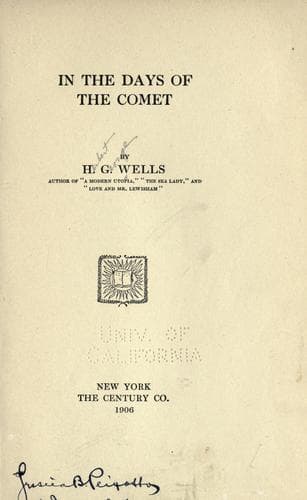
In the Days of the CometWells, H. G. (Herbert George)
Science
In the Days of the Comet
Wells, H. G. (Herbert George)
Comets -- Collisions with Earth -- Fiction; Political fiction; Science fiction; Utopian fiction; Utopias -- Fiction
“Well,” said I, “the matter seems fairly simple. You two”—I swallowed
it—“love one another.”
I paused. They answered me by silence, by a thoughtful silence.
“You belong to each other. I have thought it over and looked at it from
many points of view. I happened to want—impossible things. . . . I
behaved badly. I had no right to pursue you.” I turned to Verrall. “You
hold yourself bound to her?”
He nodded assent.
“No social influence, no fading out of all this generous clearness in
the air—for that might happen—will change you back . . . ?”
He answered me with honest eyes meeting mine, “No, Leadford, no!”
“I did not know you,” I said. “I thought of you as something very
different from this.”
“I was,” he interpolated.
“Now,” I said, “it is all changed.”
Then I halted—for my thread had slipped away from me.
“As for me,” I went on, and glanced at Nettie’s downcast face, and then
sat forward with my eyes upon the flowers between us, “since I am
swayed and shall be swayed by an affection for Nettie, since that
affection is rich with the seeds of desire, since to see her yours and
wholly yours is not to be endured by me—I must turn about and go from
you; you must avoid me and I you. . . . We must divide the world like
Jacob and Esau. . . . I must direct myself with all the will I have to
other things. After all—this passion is not life! It is perhaps for
brutes and savages, but for men. No! We must part and I must forget.
What else is there but that?”
I did not look up, I sat very tense with the red petals printing an
indelible memory in my brain, but I felt the assent of Verrall’s pose.
There were some moments of silence. Then Nettie spoke. “But———” she
said, and ceased.
I waited for a little while. I sighed and leant back in my chair. “It
is perfectly simple,” I smiled, “now that we have cool heads.”
“But IS it simple?” asked Nettie, and slashed my discourse out of
being.
I looked up and found her with her eyes on Verrall. “You see,” she
said, “I like Willie. It’s hard to say what one feels—but I don’t want
him to go away like that.”
“But then,” objected Verrall, “how———?”
“No,” said Nettie, and swept her half-arranged carnation petals back
into a heap of confusion. She began to arrange them very quickly into
one long straight line.
“It’s so difficult——— I’ve never before in all my life tried to get to
the bottom of my mind. For one thing, I’ve not treated Willie properly.
He—he counted on me. I know he did. I was his hope. I was a promised
delight—something, something to crown life—better than anything he had
ever had. And a secret pride. . . . He lived upon me. I knew—when we
two began to meet together, you and I——— It was a sort of treachery to
him———”
“Treachery!” I said. “You were only feeling your way through all these
perplexities.”
“You thought it treachery.”
“I don’t now.”
“I did. In a sense I think so still. For you had need of me.”
I made a slight protest at this doctrine and fell thinking.
Public-domain text, read in full here on John Shaqi.
Reviews
Reviews
No reviews yet
Be the first to share your thoughts on this work.
Elsewhere in the archive
Join the Discussion
Join the discussion
Sign in to leave a comment or review.
Sign InorCreate an account