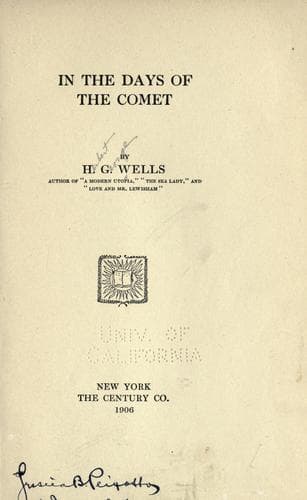
In the Days of the CometWells, H. G. (Herbert George)
Science
In the Days of the Comet
Wells, H. G. (Herbert George)
Comets -- Collisions with Earth -- Fiction; Political fiction; Science fiction; Utopian fiction; Utopias -- Fiction
Ours had been one of the first modern communes to get in order; we were
greatly helped by the energy of Lord Redcar, who had a fine feeling for
the picturesque associations of his ancestral home—the detour that took
our line through the beeches and bracken and bluebells of the West Wood
and saved the pleasant open wildness of the park was one of his
suggestions; and we had many reasons to be proud of our surroundings.
Nearly all the other communes that sprang up all over the pleasant
parkland round the industrial valley of the Four Towns, as the workers
moved out, came to us to study the architecture of the residential
squares and quadrangles with which we had replaced the back streets
between the great houses and the ecclesiastical residences about the
cathedral, and the way in which we had adapted all these buildings to
our new social needs. Some claimed to have improved on us. But they
could not emulate the rhododendron garden out beyond our shrubberies;
that was a thing altogether our own in our part of England, because of
its ripeness and of the rarity of good peat free from lime.
These gardens had been planned under the third Lord Redcar, fifty years
ago and more; they abounded in rhododendra and azaleas, and were in
places so well sheltered and sunny that great magnolias flourished and
flowered. There were tall trees smothered in crimson and yellow
climbing roses, and an endless variety of flowering shrubs and fine
conifers, and such pampas grass as no other garden can show. And barred
by the broad shadows of these, were glades and broad spaces of emerald
turf, and here and there banks of pegged roses, and flower-beds, and
banks given over some to spring bulbs, and some to primroses and
primulas and polyanthuses. My mother loved these latter banks and the
little round staring eyes of their innumerable yellow, ruddy brown, and
purple corollas, more than anything else the gardens could show, and in
the spring of the Year of Scaffolding she would go with me day after
day to the seat that showed them in the greatest multitude.
It gave her, I think, among other agreeable impressions, a sense of
gentle opulence. In the old time she had never known what it was to
have more than enough of anything agreeable in the world at all.
We would sit and think, or talk—there was a curious effect of complete
understanding between us whether we talked or were still.
“Heaven,” she said to me one day, “Heaven is a garden.”
I was moved to tease her a little. “There’s jewels, you know, walls and
gates of jewels—and singing.”
“For such as like them,” said my mother firmly, and thought for a
while. “There’ll be things for all of us, o’ course. But for me it
couldn’t be Heaven, dear, unless it was a garden—a nice sunny garden. .
. . And feeling such as we’re fond of, are close and handy by.”
Public-domain text, read in full here on John Shaqi.
Reviews
Reviews
No reviews yet
Be the first to share your thoughts on this work.
Elsewhere in the archive
Join the Discussion
Join the discussion
Sign in to leave a comment or review.
Sign InorCreate an account