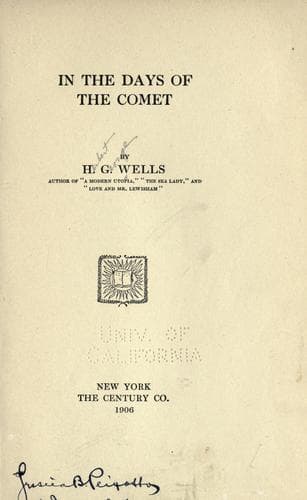
In the Days of the CometWells, H. G. (Herbert George)
Science
In the Days of the Comet
Wells, H. G. (Herbert George)
Comets -- Collisions with Earth -- Fiction; Political fiction; Science fiction; Utopian fiction; Utopias -- Fiction
You of your happier generation cannot realize the wonderfulness of
those early days in the new epoch, the sense of security, the
extraordinary effects of contrast. In the morning, except in high
summer, I was up before dawn, and breakfasted upon the swift, smooth
train, and perhaps saw the sunrise as I rushed out of the little tunnel
that pierced Clayton Crest, and so to work like a man. Now that we had
got all the homes and schools and all the softness of life away from
our coal and iron ore and clay, now that a thousand obstructive
“rights” and timidities had been swept aside, we could let ourselves
go, we merged this enterprise with that, cut across this or that
anciently obstructive piece of private land, joined and separated,
effected gigantic consolidations and gigantic economies, and the
valley, no longer a pit of squalid human tragedies and meanly
conflicting industries, grew into a sort of beauty of its own, a savage
inhuman beauty of force and machinery and flames. One was a Titan in
that Etna. Then back one came at midday to bathe and change in the
train, and so to the leisurely gossiping lunch in the club dining-room
in Lowchester House, and the refreshment of these green and sunlit
afternoon tranquillities.
Sometimes in her profounder moments my mother doubted whether all this
last phase of her life was not a dream.
“A dream,” I used to say, “a dream indeed—but a dream that is one step
nearer awakening than that nightmare of the former days.”
She found great comfort and assurance in my altered clothes—she liked
the new fashions of dress, she alleged. It was not simply altered
clothes. I did grow two inches, broaden some inches round my chest, and
increase in weight three stones before I was twenty-three. I wore a
soft brown cloth and she would caress my sleeve and admire it
greatly—she had the woman’s sense of texture very strong in her.
Sometimes she would muse upon the past, rubbing together her poor rough
hands—they never got softened—one over the other. She told me much I
had not heard before about my father, and her own early life. It was
like finding flat and faded flowers in a book still faintly sweet, to
realize that once my mother had been loved with passion; that my remote
father had once shed hot tears of tenderness in her arms. And she would
sometimes even speak tentatively in those narrow, old-world phrases
that her lips could rob of all their bitter narrowness, of Nettie.
“She wasn’t worthy of you, dear,” she would say abruptly, leaving me to
guess the person she intended.
“No man is worthy of a woman’s love,” I answered. “No woman is worthy
of a man’s. I love her, dear mother, and that you cannot alter.”
“There’s others,” she would muse.
“Not for me,” I said. “No! I didn’t fire a shot that time; I burnt my
magazine. I can’t begin again, mother, not from the beginning.”
She sighed and said no more then.
At another time she said—I think her words were: “You’ll be lonely when
I’m gone dear.”
Public-domain text, read in full here on John Shaqi.
Reviews
Reviews
No reviews yet
Be the first to share your thoughts on this work.
Elsewhere in the archive
Join the Discussion
Join the discussion
Sign in to leave a comment or review.
Sign InorCreate an account