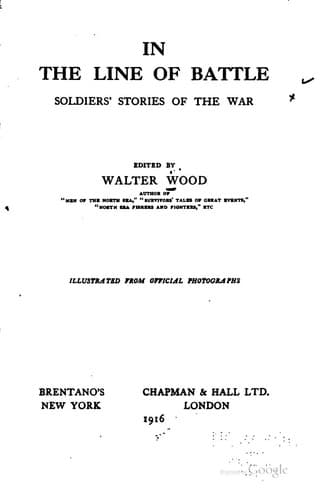
In the Line of Battle: Soldiers' Stories of the War
History
In the Line of Battle: Soldiers' Stories of the War
World War, 1914-1918 -- Personal narratives
At about three o’clock in the morning we suddenly heard the sound of
a bugle, and presently the Germans set up a hullabaloo and fairly
hurled themselves at our trenches. They came in such strong numbers
that the Indians, who had been dealing out death half the night, were
overweighted by the enemy, who got round their flank and attacked them
in the rear.
A Maxim gun section of the 11th Hussars was hurried down, and from
the window of one of the buildings it blazed away at the Germans and
covered the retirement of the Indians. The way in which the Maxims have
been handled in the war has been a revelation to a lot of people. These
handy weapons have been got into upstairs and downstairs rooms and even
into the tops of trees, and they have caused terrific havoc in the
Germans’ solid ranks.
That night affair was desperate; but it seemed as if nothing could stop
the mad onrush of the Germans, and at last there was nothing for it but
to give way, and so we received orders to evacuate the barn.
Near this particular point the road forks, and a couple of men were
left to fire up the right-hand road and two to fire up the road on the
left, and for the time being we were effectually covered.
It was at this stage that there arose the chance for a Territorial
regiment to come into action for the first time. The Territorials to
win this great distinction were the London Scottish.
The Scottish had been ordered up to relieve the pressure, and they came
on quickly and in gallant style and took up a position at one end of
the barn, while the Highland Light Infantry, the brave old 71st, took
up a position at the other, and between them the two carried the barn
with a bayonet charge and killed, captured or drove away the Germans.
The Scottish had their baptism of blood in proper good style, with a
very strange preparation in the shape of a cunning German trick.
Not far from the Scottish was a windmill which had had three of its
sails blown away or destroyed, leaving only the fourth sail, and that
looked as if it had been cut clean in half. It was noticed that this
crippled sail was working about in the most astonishing fashion, and
those who saw it were puzzled to account for the movements; but it was
soon discovered that there was a German spy hidden in the mill, and
that he was moving the sail to indicate the position of the Scottish,
and so bring the German gun-fire to bear on them. When the dodge had
been discovered and the signaller settled the Scottish got their own
back.
By this time I was blazing away from a barricade in an old covered
yard, and there was a straggling fire going on all around; but it was
clear that we should want reinforcements if we were to hold our own and
save Messines.
At last we heard shouts, and I cannot tell you what it meant to us
when we knew that the shouts came from our own fellows, and that three
battalions of infantry had hurried up and got into action and given the
Germans more than they could comfortably carry.
Public-domain text, read in full here on John Shaqi.
Reviews
Reviews
No reviews yet
Be the first to share your thoughts on this work.
Elsewhere in the archive
Join the Discussion
Join the discussion
Sign in to leave a comment or review.
Sign InorCreate an account