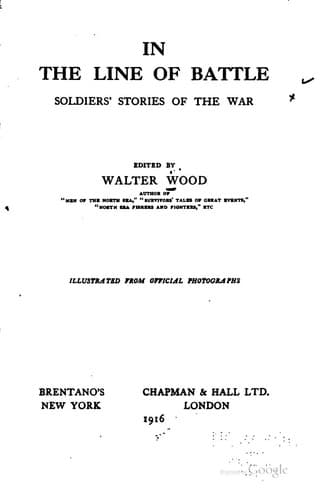
In the Line of Battle: Soldiers' Stories of the War
History
In the Line of Battle: Soldiers' Stories of the War
World War, 1914-1918 -- Personal narratives
It was at this moment of the saving of Messines that I was struck by a
shrapnel bullet and had to leave the fighting-line and come home, with
the fight for the coast going on. I had been in it right from the start
and had got used to the awful business, even to the “coal-boxes,” which
the Germans were everlastingly firing. They made a particular target of
the church, and for nine days bombarded it before they set the building
on fire.
One of the strangest things about a shell is that you never know what
it is going to do, and some of the “coal-boxes” acted like freaks.
During this bombardment of the church I watched one of the shells
come, and expected that it would do something smashing, for it hit the
building full in the middle of one of the main walls. I looked for the
wall to be shattered, but the shell never shifted a brick or a bit of
mortar; it simply burst in on itself, so to speak, and did no damage to
anything except itself, and in the end the Germans got a fire going by
sending a much smaller shell, something like a fifteen-pounder.
In a general way of speaking, however, these “coal-boxes” did some
terrible mischief when they really exploded, and no living thing within
their reach had a chance of escaping. Horses, guns, men, wagons,
everything that came within the area of explosions was shattered or
wiped out. Often enough men who were killed by the explosions were
found in the holes, so that the shell which had destroyed them had also
scooped out their grave.
There were all sorts of side issues to the actual fighting. We billeted
in every kind of building, some of them very strange; but I think the
strangest of all was a cow-house. This does not sound promising; but
that cow-house was one of the finest places I ever slept in.
The farm itself was beautiful, and everything about it was on
the latest and best scale, so that the cow-house was lighted by
electricity, and the fittings were in keeping with the illumination.
I had a very comfortable stretch there, and it would not have been
possible for us to be better looked after. The proprietor had had
notice of our coming and had made every preparation for us, and we were
only too grateful for the many good things he freely gave away. We had
the same sort of kindness shown to us by the French wherever we came
into contact with them.
It may seem somewhat odd that a cavalryman in talking of the war should
dwell so much on the trench work and the shell-fire; but in this war
a great deal of the work of the cavalry has been dismounted, and
practically the same as the infantry, and there has not been the chance
that every cavalryman longs for to get to close grips with the enemy’s
mounted forces.
Public-domain text, read in full here on John Shaqi.
Reviews
Reviews
No reviews yet
Be the first to share your thoughts on this work.
Elsewhere in the archive
Join the Discussion
Join the discussion
Sign in to leave a comment or review.
Sign InorCreate an account