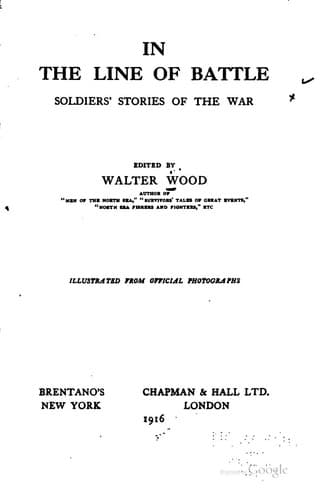
In the Line of Battle: Soldiers' Stories of the War
History
In the Line of Battle: Soldiers' Stories of the War
World War, 1914-1918 -- Personal narratives
We started again at about a quarter past six, as soon as the night
came, and for more than three mortal hours we made this strange journey
down the hillside; and at last, with real thankfulness, we reached the
bottom and came to a bit of a wood. Sweet beyond expression it was to
feel that I could walk upright, and that I was near the British lines.
This knowledge came to me suddenly when there rang through the night
the command: “Halt!”
I obeyed--glorious it was to hear that challenge in my native tongue,
after what we had gone through. Then this good English sentry said,
“Come up and be recognised!” not quite according to the regulation
challenge, but good enough--and he had seen us quite clearly in the
moonshine.
Up I went, and found myself face to face with the sentry, whose rifle
was presented ready for use, and whose bayonet gleamed in the cold
light.
“What are you doing?” said the sentry. “Are you burying the dead?”
I saw that he was sentry over a trench, and I went to the top of it and
leaned over the parapet and said, “Can you give me a hand?”
“What’s up?” said the sentry, who did not seem to realise what had
actually happened--and how could he, in such a strange affair?
“I’ve got a chap out here wounded,” I told him, “and I’ve dragged him
down the hill on a shovel.”
The sentry seemed to understand like a flash. He walked up to the
trench, and when I had made myself clear, three or four chaps bustled
round and got a blanket, and I led them to the spot where I had left
Andrews lying on the ground. We lifted him off the shovel, put him on
the blanket, and carried him to the trench. These men were, I think,
Inniskilling Fusiliers, and they did everything for us that human
kindness could suggest. They gave me some rum and bully beef and
biscuit, and it was about the most delightful meal I ever had in my
life, because I was famishing and I was safe, with Andrews, after those
dreadful hours on the hillside, which seemed as if they would never end.
When we had rested and pulled round a bit, we were put on stretchers
and carried to the nearest dressing-station. Afterwards we were sent to
Malta, where Andrews is, I believe, still in hospital.
The granting of the Victoria Cross for what I had done came as a
complete surprise to me, because it never struck me that I had done
more than any other British soldier would have done for a comrade.
I never lost heart during the time I was lying on Hill 70. All the old
things came clearly up in my mind, and many an old prayer was uttered,
Andrews joining in. We never lost hope that some way out of our peril
would be found--and it seemed as if our prayers had been answered by
giving us this inspiration of the shovel.
CHAPTER II
A PRISONER OF WAR IN GERMANY
Public-domain text, read in full here on John Shaqi.
Reviews
Reviews
No reviews yet
Be the first to share your thoughts on this work.
Join the Discussion
Join the discussion
Sign in to leave a comment or review.
Sign InorCreate an account