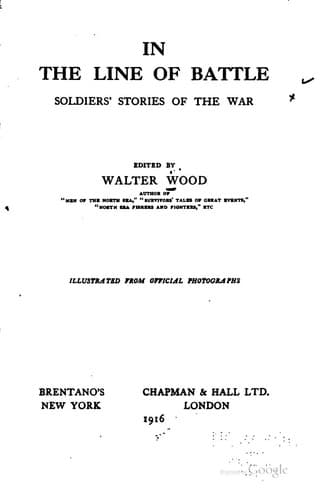
In the Line of Battle: Soldiers' Stories of the War
History
In the Line of Battle: Soldiers' Stories of the War
World War, 1914-1918 -- Personal narratives
At the front I saw men who came from all parts of the country where I
have been working for the past twenty-five years--Canadians, Americans,
and so on. And in passing just let me say that in connection with
this war we are misjudging America because of the attitude which
the President has taken. I have stayed with Mr. Wilson and with Mr.
Roosevelt, and I know that the spirit of America is with us. It is
because the whole spirit of the American people is with us that
thirty-three doctors and thirty-six nurses--most of them giving up
splendid practices--went out from America to the front, as the Harvard
Unit, to help us. Just so the Chicago Unit, and many more Americans
fighting in the ranks.
I have seen at the front men of all ages and of every rank in
life--veterans who were a long way over the army age, and immature
youths of sixteen or seventeen. The spirit of loyalty and the
determination to do their bit made them go. Often enough a boyish
patient would smile when I looked at the chart and asked him how old he
really was. “Oh, that’s my Army age,” he would say, and go on smiling.
I was right round the trenches two weeks ago, and as that was early
in March and the winter has been exceptionally bad, the conditions
were intolerable. There is no anxiety, because everybody is sure that
the line is strong; but the wet, mud and exposure make you think that
the men will get pneumonia and bronchitis; yet what mostly happens is
trench-foot. I have seen a lot of that in Labrador, where we call it
frost-bite. It is not, however, the same, though it appears to be. I
have travelled many times in Labrador in winter, when the thermometer
has been twenty and thirty degrees below zero, and I have never had
frost-bite except once in my life. That was when I was driving my
dog-team over the ice. The ice broke and my dogs went into the sea.
They shared a floe with me throughout an awful night, and my life was
saved at the sacrifice of theirs. I have told that story in detail
elsewhere, so I need not tell it now.
I saw 150 men from a Highland regiment with frost-bite, but that was
quite exceptional, and was due to the phenomenal weather and the
impossibility of relieving the men when their relief was due, because
they were fighting continuously for over forty-eight hours.
[Illustration:
_To face p. 234._
BACK TO PRIMEVAL LIFE. AT THE END OF A TRENCH, SHOWING A FIRE WHICH
COOKS AND GIVES WARMTH.]
There is another direction in which immense strides have been made, and
that is with respect to vermin. At one time, at the beginning of the
war, there were as many as 4000 men who had scabies, or itch, and were
out of action for the time being; but you hardly see such a case now,
because of the wonderful measures which are taken to keep the troops
perfectly clean and fit.
Public-domain text, read in full here on John Shaqi.
Reviews
Reviews
No reviews yet
Be the first to share your thoughts on this work.
Elsewhere in the archive
Join the Discussion
Join the discussion
Sign in to leave a comment or review.
Sign InorCreate an account