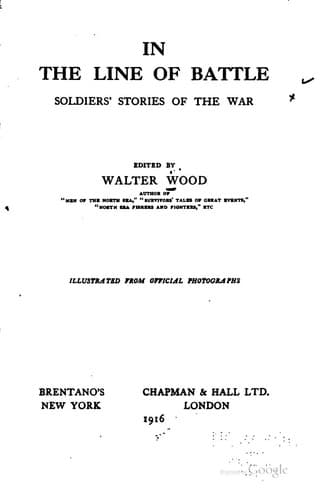
In the Line of Battle: Soldiers' Stories of the War
History
In the Line of Battle: Soldiers' Stories of the War
World War, 1914-1918 -- Personal narratives
Close behind the trenches immense vats have been placed to serve as
baths for the men, and the happiest fellows I saw were those who were
rolling and splashing in these hot baths, while their uniforms and
clothing were being thoroughly cleansed in super-heated steam-chests
and finished off with heavy hot irons.
Just as we got into one of these cleaning depots a Jack Johnson burst
very near us, but nobody took the slightest notice of it, so accustomed
does one become to the happenings of war. Five or six men were in each
hot bath, and something like 2000 baths a day are given. The men become
thoroughly clean personally, and their clothing also is perfectly freed
from vermin and filth, and the troops look as happy as possible.
I was greatly struck by the coolness and courage of all who worked in
these laundries, women as well as men, and I could not help thinking
that if I stood one week of it I should be entitled to the D.S.O.
Endless thousands of uniforms, socks and articles of underclothing are
constantly dealt with in the manner I have described, and many of the
workers are under artillery fire all the time.
In the treatment of bad wounds, too, there has been a very great
advance, and for such cases as broken femurs such an ingenious device
has been hit upon that you might well say that instead of putting a
man into bed you put the bed on to the man. The R.A.M.C. is really
doing its very best, and I shall go back to America feeling perfectly
satisfied that the British soldier is getting all the attention that I
could wish to have myself.
When the war began the surgeons did not know where to put the wounded,
because of the varying fortunes of the fighting. Even Boulogne, Calais
and Havre were not certain of safety, so that attending to the wounded
and accommodating them was a precarious thing; but the temporary
hospitals have been gradually replaced by stationary hospitals, the
mobile makeshift has been succeeded by the permanent institution, and
so splendid and complete are our resources now that in one day the
enormous total of 100,000 casualties could be dealt with by the R.A.M.C.
Casualty clearing-stations, field ambulances, advanced dressing-posts
and fixed hospitals are about as perfect as they can be made; and so
admirable are the arrangements that I saw one man who had been shot
through the abdomen and was in hospital in less than an hour from the
time he was wounded--which is almost quicker than you would do it in
London.
A great many of the less seriously sick and wounded do not have to go
to the base at all; at times one rest-camp was sending 80 per cent,
straight back to the line, entirely new men; and, as they say in
America, it would “tickle you to death” to see how these things are
done.
Public-domain text, read in full here on John Shaqi.
Reviews
Reviews
No reviews yet
Be the first to share your thoughts on this work.
Elsewhere in the archive
Join the Discussion
Join the discussion
Sign in to leave a comment or review.
Sign InorCreate an account