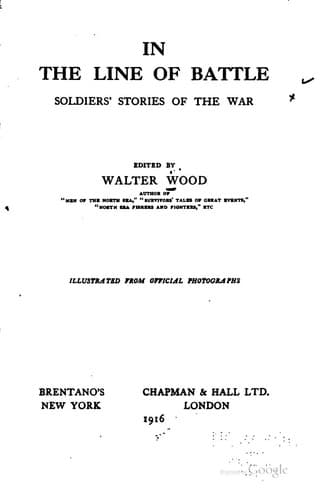
In the Line of Battle: Soldiers' Stories of the War
History
In the Line of Battle: Soldiers' Stories of the War
World War, 1914-1918 -- Personal narratives
Let me give another illustration of the German way of treating wounded
British soldiers. Just after Christmas I was moved into an open camp at
Münster, and the only covering I had was a tarpaulin, the result being
that I caught cold in my wound, and on January 2nd I was moved back
into another hospital. I knew nothing whatever about the regulations
of the place, so that I saw nothing wrong in walking along an ordinary
looking passage. As I did this there came towards me a man who
corresponds in rank to our regimental sergeant-major. I was suffering
greatly from my stump, and was quite helpless; yet this fellow seized
me by the scruff of the neck and the seat of the trousers and threw me
out of the passage--and it was not till later that I learned that the
passage led to the operating-room, and that patients were not allowed
to use it. Such a thing could not possibly happen in a British military
hospital containing wounded German soldiers. It is only fair to say
that the food we got in hospital was good.
Though my wound was not healed, I was sent away from the hospital
and back to the camp. That was bad in some ways, but it had a fine
compensation, for I was attended by two of our own medical officers of
the Royal Army Medical Corps who were also prisoners--Captain Rose and
Captain Croker. I believe they have been exchanged now. I need not say
what a joy it was to be looked after by our own splendid doctors, after
my experience of German brutality and callousness.
[Illustration:
_To face p. 24._
A BRITISH SOLDIER HELPING A WOUNDED GERMAN PRISONER INTO A
CONVEYANCE.]
Time passed slowly and very wearily, and the monotony became deadly.
It was bitterly cold, and snow fell heavily and constantly till about
April. We did our best to keep cheerful and fit, and were always
thankful when we could get a chance of playing games. Sometimes we
played football with our sentries; but they were sorry sportsmen, and
could not endure being beaten, even in fair football. There were some
Royal Welsh Fusiliers amongst the prisoners, and three footballs had
been sent out to them. These footballs reached the camp safely, and
everybody was hugely pleased with them. We got up a match between a
British team and the German sentries, and beat them six to one. It
was a straightforward, honest match, and a fair and square win; but
the Germans could not stomach it, and for three days our smoking was
stopped. No reason for the stoppage was given; but we knew well enough
what the cause was, especially as the order applied only to the British
prisoners of war.
Public-domain text, read in full here on John Shaqi.
Reviews
Reviews
No reviews yet
Be the first to share your thoughts on this work.
Join the Discussion
Join the discussion
Sign in to leave a comment or review.
Sign InorCreate an account