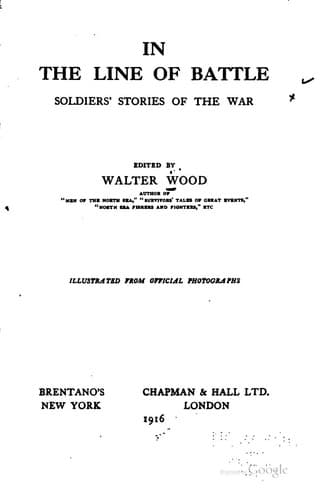
In the Line of Battle: Soldiers' Stories of the War
History
In the Line of Battle: Soldiers' Stories of the War
World War, 1914-1918 -- Personal narratives
There was nothing to be seen in the air, yet suddenly, and without any
apparent cause, we were overpowered by a smell exactly like nasturtium,
but infinitely stronger and more pungent. The similarity noticed
is remarkable, for doesn’t nasturtium come from Latin words which
really mean a nose-twister? Anyway, there we were in our trenches,
unexpectedly overpowered by a horrible acrid smell and an invisible gas.
A lot of the boys--fine, splendid, honest fellows, who did not
understand the meaning of any kind of warfare that is not honourable
and aboveboard, were utterly unable to fathom the mystery, and they
seemed to think that it was the kind of pest that had to be taken with
the other discomforts of campaigning in the Low Country.
“What the deuce is it?” they asked.
It was not until the whole unspeakable visitation was over that most
of the men realised what had happened, and that the Germans had tried
to blind us as a preliminary to annihilation. Like so many more of the
German hopes, this did not develop on the lines that had been planned.
This was the first poison-gas attack that we experienced, and I am
thankful to say that on the whole it was a failure; but when you
remember that we were utterly unready for such a filthy form of
fighting, and that we had no means of combating it or nullifying its
effects, you will realise the extreme disadvantage of the contest from
the point of view of the Canadians.
I have said that it was about four o’clock in the afternoon when we had
our first experience of the poison-gas. Now that I am talking of the
thing it strikes me as a strange coincidence that it was at about four
o’clock in the morning when we had our second visitation.
We had got into our stride and settled down to hard hammering and what
you might call routine campaigning. Then came the morning of Saturday,
April 24th, when the sun rose ten minutes before five o’clock, which
means that at about four o’clock day was breaking.
Most of us were asleep; but in war time there is no such thing as
universal rest for men, and our sentries were posted and keeping
watchful eyes upon the German lines. It is said that the darkest hour
comes just before the dawn, and I think there is no doubt that man’s
lowest vitality is reached at that particular period. At any rate, the
Germans probably thought so, for they planned a specially fatal attack
upon us in the grey hours of this April morning.
While looking round in the cheerless dawn one or two of our sentries
saw a yellowish kind of cloud coming towards us, over the hogback, and
travelling pretty fast. The sight was unusual enough to be noticed, but
no one who saw it had the slightest idea what it really was, until we
were enveloped in the filthy folds; then we knew that it was poison-gas.
Public-domain text, read in full here on John Shaqi.
Reviews
Reviews
No reviews yet
Be the first to share your thoughts on this work.
Join the Discussion
Join the discussion
Sign in to leave a comment or review.
Sign InorCreate an account