In the Line of Battle: Soldiers' Stories of the War — John Shaqi
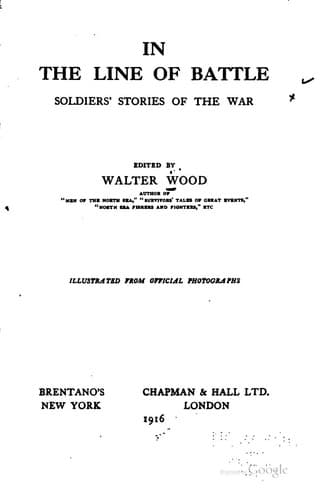
In the Line of Battle: Soldiers' Stories of the War
History
In the Line of Battle: Soldiers' Stories of the War
World War, 1914-1918 -- Personal narratives
It was all tremendously exciting, and there was never a chance of being
dull or downhearted. The system of trenches was amazing, turning and
twisting everywhere in the most wonderful manner. We made the most of
these complications, too, by naming the trenches Oxford Street, Regent
Street, and so on, with Clapham Junction and the like for important
junctions of trenches. These names, which were chalked up or put on
boards, were most useful in helping you to find your way about, and
sometimes very amusing misunderstandings arose.
“Do you know where Oxford Circus is?” a chap asked me one day.
“Rather!” I told him, proud to throw light on his ignorance, and I
began to tell him, till he cut me short by snapping that he wasn’t
talking about London, but the trenches. We got many a good laugh
out of these little misunderstandings; for out at the front you are
always ready to make the most of the smallest joke. You needed all
the cheerfulness you could get, too, because of the awful sights that
constantly met you and the endless peril you were in. I shall never
forget one of the very first things my eyes saw in those opening
days of my campaigning in Gallipoli. We got to the spot at Achi Baba
where the Munsters and the Dublin Fusiliers, during a gallant advance,
had been enfiladed by machine-gun fire and literally mown down. From
the trench we had occupied we could see the men lying just as they
had fallen, while trying to take cover. There they were, on the open
ground, absolutely riddled with bullets, and with their packs on, and
their rifles and bayonets and everything else. They had been lying
there for about a fortnight, because it was impossible to do anything
in the way of burying them, owing to the enemy’s incessant fire and
sniping.
Things hereabouts were particularly horrible. We went into a Turkish
trench that had been taken, and started to make a fire-trench. We
pulled away the old sandbags and dug away at the parapet with our
picks. There was a horrible stench, but we were used to smells and
did not take much notice of it till we found that the picks had a lot
of foul stuff on them which we could not account for; but we soon
discovered that the parapet was composed of the dead bodies of Turks
which had been piled up and just covered with earth, the sandbags being
placed on the top of the wall of corpses.
In this same trench there was a well which had been covered with
planks. Naturally enough we began to explore it, not that we expected
to get anything to drink from it, and when we had removed the planks we
found that the well, which we calculated was ten or twelve feet deep,
had a lot of dead Turks in it. We counted six of them, and had enough
of the job, so we put the planks back, and felt that our curiosity had
been satisfied.
Public-domain text, read in full here on John Shaqi.
Reviews
Reviews
No reviews yet
Be the first to share your thoughts on this work.
Join the Discussion
Join the discussion
Sign in to leave a comment or review.
Sign InorCreate an account