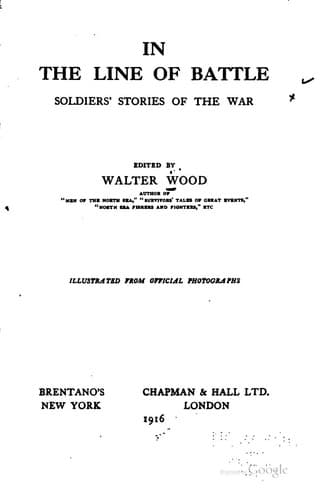
In the Line of Battle: Soldiers' Stories of the War
History
In the Line of Battle: Soldiers' Stories of the War
World War, 1914-1918 -- Personal narratives
The German attack not having materialised, we were able to retire to
the trenches and make them habitable. Before this could be done we had
to get the wounded out and bury the dead. As a rule, we had dug a grave
for each man, but now there were so many of the killed that we had to
put the bodies side by side in long trenches, which we made just behind
the line. Quite a cemetery came into existence there, and we did our
best to make it nice and worthy to be the resting-place of those who
had given their lives for their country.
There is one feature of this great war which has been lost sight of to
some extent, and that is the tremendous call which has been made on
the physical endurance of the men, quite apart from the ceaseless and
excessive strain on the nerves and mind. I will give one illustration
on this point.
On the night of March 10th, during the battle of Neuve Chapelle, the
front line ran short of ammunition and the Kensingtons were ordered
to take up a supply. First of all we had to load up with our little
lot, and, as it was impossible to carry the ammunition in the cases,
each man got a score of canvas bandoliers across his shoulders, in
addition to his own kit and rifle, and he had to stagger along with
this tremendous weight, the filled bandoliers alone representing
about eighty pounds; so that with the rifle and standing kit each man
carried a burden of considerably more than a hundredweight. That was
bad enough, but matters were made infinitely worse by the fact that
we had to go along a newly-made road, or rather track. This road had
been constructed by the Gurkhas, by the simple plan of putting bricks
down almost anyhow--there were plenty of bricks handy from the ruined
buildings all around us; so that the road we had to take was rather
like the huge teeth of an enormous saw, for there was no steam roller
to flatten down the surface.
In the darkness, under constant fire, we staggered and stumbled along
with our ammunition; but even the biggest and strongest amongst us
could not do more than cover about a hundred yards at a time. If a man
did that he was proud and thankful, and having got a bit of rest as
best he could--and that was by hunking up and resting on the rifle, for
if a man had really got on to the ground he would have been hard put to
it to rise again--we forged slowly ahead.
We had been ordered to take the ammunition into a house that was
battered, but was more whole than the rest--it was really only a
skeleton of a building--and having reached the house we very gladly
dumped our bandoliers down in the garden. To reach the garden was quite
a simple matter--all we had to do was to dash through a big hole in the
side of the house, made by artillery fire, and I give you my word that
we lost no time in shedding our burden of bandoliers.
Public-domain text, read in full here on John Shaqi.
Reviews
Reviews
No reviews yet
Be the first to share your thoughts on this work.
Elsewhere in the archive
Join the Discussion
Join the discussion
Sign in to leave a comment or review.
Sign InorCreate an account