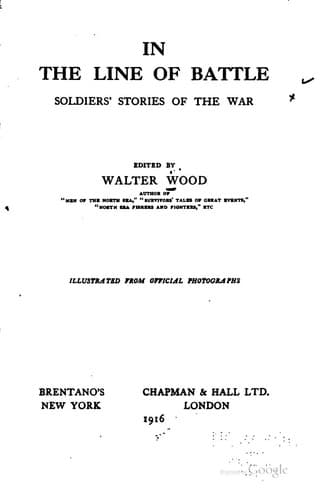
In the Line of Battle: Soldiers' Stories of the War
History
In the Line of Battle: Soldiers' Stories of the War
World War, 1914-1918 -- Personal narratives
It was a most exciting little performance from start to finish, yet it
put a terrific strain on every man who took part in it--load yourself
up with more than a hundredweight of stuff and see what it feels
like; then you will partly realise what we had to go through--and the
excitement was by no means ended when we reached the garden in the
darkness, because just as we were getting rid of the bandoliers a shell
crashed into the house next to us and smashed it to smithereens, a lot
of our chaps being fairly smothered in the flying bricks and rubbish.
That _was_ a night, and one that I shall never forget.
There seemed every prospect that we should be fairly mopped up, and
when the order came for the N.C.O.’s to take back the men in parties we
lost no time in returning, as best we could, to the trenches. Shelling
was going on all the time, and just by way of giving a finish to the
performance something like thirty star-shells burst together, making
the dark night as light as day and giving the Germans a chance to plump
more shells into us as we got back. This hurrying up with ammunition to
the firing-line is only one of many such things that have been done as
part of the day’s work by British soldiers at the front.
About two nights afterwards these two Line battalions of which I speak
were relieved, and we took over their trenches. There were no dug-outs,
or any such protections; the trenches were simply breastworks, and we
had a very bad time when the wet weather set in, as it did.
When we took the trenches over they were in an unfinished state, and we
set to work at once to complete them. One night, or rather about two
o’clock in the morning, I was working on the top of the back parapet,
with my head and shoulders showing, and half asleep, for I was dead
tired. Suddenly the Germans sent up about fifty star-shells, which
burst in the sky and made the darkness as light as day and showed us up
as clearly as possible. Instantly the enemy opened rapid fire on our
trenches and swept us with machine-guns, the bullets whistling over the
parapets.
I was roused as swiftly as if the réveillé had sounded--perhaps faster,
because there are no whizzing bullets when the bugles blow--and I well
remember that I wriggled and rolled sideways. I knew that the darkness
had become as light as daytime and that the German fire was peppering
us, and that the best thing to do was to get out of it as rapidly as
I could. So I fell flat, then lay still, then rolled into a trench as
best I could. I remember--so soon do we get accustomed to war--that
one of our chaps growled, “Why don’t you go a bit farther, then you
could go through an opening!” Fancy a chap picking and choosing a
landing-place when he was clearing out from shell-fire! I knew that in
rolling and falling like this there was a risk of landing on top of a
fixed bayonet, as some of our fellows did, but I cheerfully took that
chance in my eagerness to get under cover.
Public-domain text, read in full here on John Shaqi.
Reviews
Reviews
No reviews yet
Be the first to share your thoughts on this work.
Elsewhere in the archive
Join the Discussion
Join the discussion
Sign in to leave a comment or review.
Sign InorCreate an account