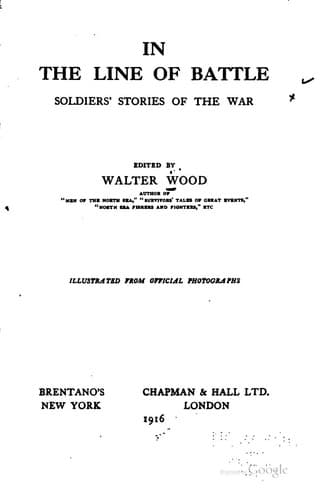
In the Line of Battle: Soldiers' Stories of the War
History
In the Line of Battle: Soldiers' Stories of the War
World War, 1914-1918 -- Personal narratives
From Alexandria we sailed in a transport, which occupied four days in
reaching Gallipoli. Here we were transhipped to trawlers and barges,
and immediately found ourselves in the thick of one of the most
tremendous bombardments the world has ever known. Battleships were
firing their big guns, which made a terrific noise, and there was
other continual firing of every known sort. We were very lucky in our
landing, because we escaped some of the heaviest of the gun-fire. The
Turks could see us, though we had no sight of them, and whenever a
cluster of us was spotted, a shell came crashing over. Thus we had our
baptism of fire at the very start.
We were in an extraordinarily difficult country, and whatever we needed
in the way of food and drink we had to carry with us--even the water.
Immense numbers of tins had been filled from the Nile and taken to
Gallipoli in barges, and this was the water we used for drinking
purposes, as well as water which was condensed from the sea, and kept
in big tanks on the shore. Every drop of water we needed had to be
fetched from the shore, and this work proved about the hardest and
most dangerous of any we had to do after landing and taking up our
position on a hill. Several of our chaps were knocked over in this
water-fetching work.
While we were at this place we were employed in making roads from Suvla
Bay to Anzac, and hard work it was, because the country was all rocks.
We had landed light, without blankets or waterproofs, so that we felt
the intense cold of the nights very much.
We had a week of this sort of thing, under fire all the time. I think
it was on a Sunday we landed, and a week later we heard that we were
to take part in the attack on Hill 70, or, as we called it, because
of its appearance, Burnt Hill. There were immense quantities of a
horrible sort of scrub on it, and a great deal of this stuff had been
fired and charred by gun-fire. I little knew then how close and long an
acquaintance I was to make with the scrub on Hill 70.
It was about five o’clock in the evening when the great news came. We
were to be ready at seven, and ready we were, glad to be in it. We did
not know much, but we understood that we were to take our places in
some reserve trenches. Night comes quickly in those regions, and when
the day had gone we moved round to Anzac, marching along the roads
which we had partially made. We reached Anzac at about two o’clock in
the morning, in pitch darkness.
We had a pick and two shovels to four men, and took it in turn to carry
them. Each man also carried two hundred rounds of ammunition, so that
we were pretty well laden. When we reached Anzac Cove we moved in
right under the cliffs, which go sheer down to the sea; but there is
practically no tide, so that the beach is safe. The only way to reach
the shore was to go in single file down a narrow, twisting pathway.
Public-domain text, read in full here on John Shaqi.
Reviews
Reviews
No reviews yet
Be the first to share your thoughts on this work.
Join the Discussion
Join the discussion
Sign in to leave a comment or review.
Sign InorCreate an account