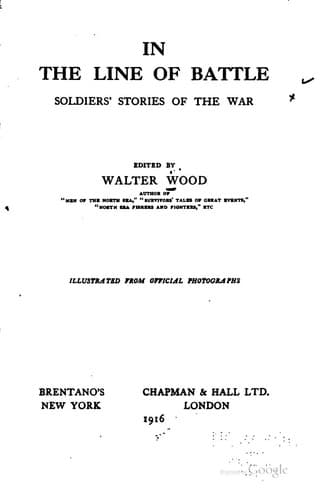
In the Line of Battle: Soldiers' Stories of the War
History
In the Line of Battle: Soldiers' Stories of the War
World War, 1914-1918 -- Personal narratives
I was a Reservist of the Royal Irish Fusiliers, and had done seven
years with the colours, so I at once went to my old home. I will
confess that I was a bit downhearted, because my brother, also a
Reservist, had come home, too, and he had the pain of saying good-bye
to his wife, as well as to our parents. But we made the best of things,
and it was the better for the two of us because we both belonged to the
same battalion.
How many of us who assembled at Euston Station for the journey to our
depot in County Armagh, Ireland, are left, I wonder? Not many, there
cannot be, for the Royal Irish Fusiliers have suffered terribly in the
war. The old soldiers assembled with brave hearts and were full of
fun, and left Euston singing “Tipperary” in fine form. I well remember
how much amused we were, when crossing in the boat, at a man who had
come from Lancashire. He was wearing wooden clogs, and had a bottle of
whisky with him; and he sang and danced and became particularly lively,
and we thoroughly enjoyed his performance. At the depot we found our
clothes and equipment waiting for us, and next day a big draft of
us set out for England, my brother and myself amongst them. It was
wonderful to see the draft and realise that here were fully trained
soldiers, completely equipped, ready to take the field, and yet only a
few hours ago many of the men were in civil life in various parts of
the United Kingdom.
I had the strange experience of dealing with German soldiers before
we left England, for a score of us were given ammunition and driven
to Folkestone Harbour Station to meet a train of German Reservists
who were trying to get away by a boat which was lying in the harbour,
ready to take them to the Fatherland by way of Flushing. But the German
Reservists didn’t get off, and they had a big surprise when they saw us
waiting for them. We searched them, of course, and found that several
of the men were carrying arms. We took them to Christ’s Hospital,
the beautiful building in Surrey, and I suppose that they are still
prisoners of war in England. These men were the usual type of Germans
who were so often seen in London--waiters, and barbers, and so on,
and I fancy that some of them were not sorry to be just too late to
join the German Army. I cannot help thinking how different were these
“reservists” to the long-service men who had rejoined the British
colours.
Public-domain text, read in full here on John Shaqi.
Reviews
Reviews
No reviews yet
Be the first to share your thoughts on this work.
Elsewhere in the archive
Join the Discussion
Join the discussion
Sign in to leave a comment or review.
Sign InorCreate an account