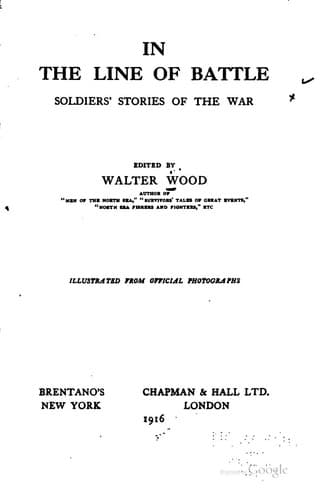
In the Line of Battle: Soldiers' Stories of the War
History
In the Line of Battle: Soldiers' Stories of the War
World War, 1914-1918 -- Personal narratives
I am not going into any details of the earlier part of the war; but
I was not long before I saw a few more German prisoners on the other
side. We had marched two days without seeing the enemy, then our scouts
returned with three prisoners. The scouts told us that they had banged
into the Germans, who were retreating fast, and had captured these
three fellows. I was deeply interested in the prisoners, because they
were the first German soldiers I had seen. They struck me as being
somewhat miserable specimens, but that was perhaps because they seemed
very hungry. They looked better when we had given them some biscuit,
which of course we did at once.
Very soon after that I saw a farm which our artillery had hit, and
which was in ruins and full of dead Germans. They had not had much of a
chance against the British gunners, and I noticed that along the road
leading to the farm ammunition was lying in heaps. It was a gruesome
place to billet in; but in spite of the German dead we passed quite a
comfortable night at the farm. Next day we were on the move again, and
reached a river where a bridge had been blown up. This delayed us till
the following morning, as our transport could not cross. But we found
a way out of that trouble by taking the transport along a railway, and
a rough, hard job it was, too, for we needed four horses and men with
ropes to do the hauling, as the wheels kept getting stuck between the
sleepers. But in spite of all the difficulties we got the transport
across, and reached a town which the Germans had passed through; and we
did not want telling which way they had gone, as we could see champagne
bottles and wine bottles along the road for miles--drink which the
Germans had looted from the town.
Drink and outrage and destruction marked the path of the German troops,
wherever they had been, in those early unforgettable stages of the war,
just as they did afterwards; though I believe that now, when they know
that they are outcasts from civilisation, the Germans are disposed
to mend their ways, if only to get better treatment when the final
reckoning comes.
Public-domain text, read in full here on John Shaqi.
Reviews
Reviews
No reviews yet
Be the first to share your thoughts on this work.
Elsewhere in the archive
Join the Discussion
Join the discussion
Sign in to leave a comment or review.
Sign InorCreate an account