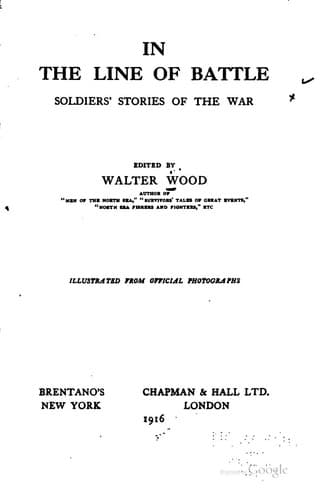
In the Line of Battle: Soldiers' Stories of the War
History
In the Line of Battle: Soldiers' Stories of the War
World War, 1914-1918 -- Personal narratives
When we reached the Aisne we found that a bridge by which we were to
cross was blown up; but our engineers soon repaired the bridge, which
had not been destroyed properly, so that it was strong enough to carry
us. Having crossed the river, three regiments went to the tops of the
hills and entrenched--the Warwicks, the Dublin Fusiliers, and the
Seaforths, our own regiment being left in reserve at the back of a
village.
The French troops were on our left, in front of Soissons, and we used
to see their artillery galloping across the plain with ammunition for
the guns. The French use mules and not horses for their batteries, and
once we saw some artillery galloping in fine style under German fire.
When the guns were passing near us four shells landed amongst the
limbers, but no one was hurt, and on seeing this we gave the Frenchmen
a tremendous cheer, for luck, and they replied with cheers and wild
waving of whips as they galloped away and nearer into the fire zone.
I remember that day well, because on the night of it we had to go and
bury thirty-five of our artillery horses that had been killed.
Next day was our turn for shell fire from the Germans. The shells
landed right into us, but we were lucky--only one man was killed though
several were wounded. We advanced up the hill, out of the way of the
fire; but as we moved the enemy gave us shrapnel, and the shelling
became so heavy that half-way up the hill we dug ourselves in.
While we were going up the hill, in short rushes, just like an ordinary
field day, and without any confusion, an artillery corporal, whose
name I do not know, showed splendid courage and uncommon strength
in carrying several of our men to a hospital which the Germans were
shelling. For his bravery he received the French Médaille Militaire.
Our transport had a very rough time, for out of fifty horses no fewer
than forty-two were killed or had to be shot. Twenty men were picked
out, myself amongst them, and sent back some distance for new horses,
and I am glad to say that we returned safely with the animals.
I was then put on guard over a bridge which was a special favourite
with spies. They were always trying to get through, but in most cases
they failed, and being caught and found out, there was no waste of time
in shooting them, after trial by court martial. After being relieved at
this place by French Alpine troops we entrained for St. Omer, the place
I have mentioned, and from St. Omer we were rushed in French motor
lorries for about sixteen miles, to a village where we rested for the
night. Next morning we were told that the Germans were on a hill six
miles away.
Public-domain text, read in full here on John Shaqi.
Reviews
Reviews
No reviews yet
Be the first to share your thoughts on this work.
Elsewhere in the archive
Join the Discussion
Join the discussion
Sign in to leave a comment or review.
Sign InorCreate an account