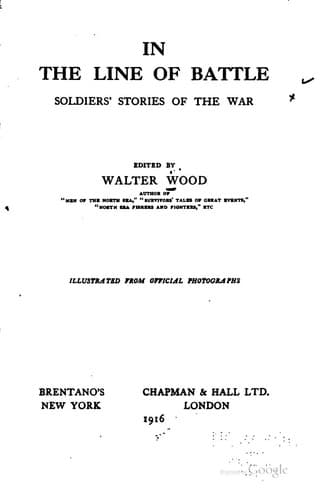
In the Line of Battle: Soldiers' Stories of the War
History
In the Line of Battle: Soldiers' Stories of the War
World War, 1914-1918 -- Personal narratives
I shall never forget that day, because it rained in torrents, and it
was a sodden regiment that trudged through the mud and mire and swished
across drenched fields. It was not exhilarating, but we were soon
warmed up by the German fire. We were ordered to lie down, and down we
lay in a field of swedes, so we fairly flopped into beds of mud and
water, just about completing our discomfort.
The rain was pattering down like tiny bullets, but we also got a shower
of the real things, and you could hear the bullets “zip” into the
leaves of the swedes. It was intensely trying and very miserable to be
in such an exposed place, and we were glad when the order came to fix
bayonets, ready for a charge. We fixed bayonets, but had to wait some
time before the order to charge came; then we heard the word we wanted,
and up we rose and off we went. The firing became hotter than ever, and
several of our men were killed and wounded before the top of the hill
was reached.
There was not much commotion as we advanced, but somewhere a Seaforth
Highlander was playing bagpipes, and the skirl helped the boys along.
We expected some stiff work when we reached the top of the hill; but
when we got there we were astonished to find that the Germans had gone,
taking their wounded with them. We were after the enemy so quickly,
however, that they had to leave their wounded, who fell into our hands,
and of course got exactly the same treatment as if they had been
British soldiers. A hundred and three of the poor beggars had been left
in a convent for the nuns to look after, so you may be sure that they
had been well cared for before they became our prisoners.
The Germans at this stage were retiring rapidly, and we kept them
on the run. We soon came to a little village, where we found that
the Germans had put sandbags in the church tower and had planted a
machine-gun in the tower. A French flag which was flying on the tower
the day before had been dragged down by the Germans and torn to pieces.
We looked upon the flag with sadness, for here again we had evidence
of German brutalities--in their retirement the soldiers had maltreated
the women, and they had battered down doors and smashed windows in
their savage determination to enter houses. They accused the villagers
of firing on them--though the villagers had nothing but a few old
useless firearms, which we saw. In spite of this they declared that a
man had fired on them, and they shot him. The body was taken away by a
priest. These things, I can assure you, roused us up properly, and we
put plenty of heart into our continued pursuit of the Germans; but they
were flying so fast that they were very hard to catch.
Public-domain text, read in full here on John Shaqi.
Reviews
Reviews
No reviews yet
Be the first to share your thoughts on this work.
Elsewhere in the archive
Join the Discussion
Join the discussion
Sign in to leave a comment or review.
Sign InorCreate an account