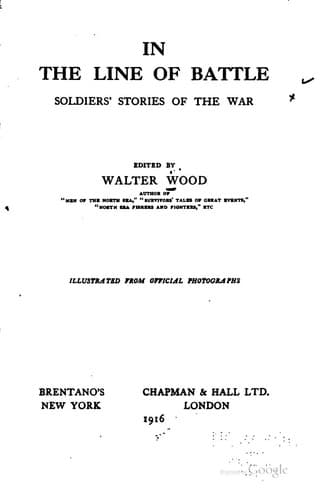
In the Line of Battle: Soldiers' Stories of the War
History
In the Line of Battle: Soldiers' Stories of the War
World War, 1914-1918 -- Personal narratives
We came up with them in the big town of Armentières, and were so close
to them that as we entered the town our scouts came back and told us
that the enemy were just leaving it at the other end. As we entered
the town we were cheered enthusiastically by the French, who seemed to
look upon us as deliverers, and so loaded us up with gifts of chocolate
bread, matches and so on that we had to throw half the things away.
Going into Armentières on the very heels of the Germans was an exciting
and dangerous performance, and as we advanced along the streets we went
on each side, not knowing on which side shots would come from windows,
but ready for anything that happened, as the men on one side had their
rifles handy for any German that appeared on the other. This was a
better plan than being on the look-out for trouble from the windows
just above your head. Luckily not many shots were fired upon us at
this stage; but we soon came to a farm where one of the most desperate
little fights that I can call to mind took place.
We were wary in entering the farm, for we saw at once the sort of
thing we had to tackle. There were four Germans concealed in a cellar
the window of which was on a level with the ground, so they had full
control of the yard and the entrance-gate.
Some of our boys, with Captain Carbury, went in and tried to persuade
the Germans to surrender, but their answer to the coaxing was a volley
which killed the officer and wounded the men. The captain was terribly
mutilated, for he had been struck full on the body, not by an ordinary
honest bullet, but an explosive bullet, and the men had been badly
hurt. As they lay on the ground they cried for help, and all the time
the Germans were firing on them and succeeded in hitting them on the
legs and shoulders. Two of our men, brave fellows, volunteered to try
and save their wounded comrades, and they dashed into the yard, only to
be shot and killed as soon as they entered. One of these fine chaps was
Lance-Corporal Shield, but I do not know the name of the other.
It was useless to waste further life in the attempt to get the Germans
out of their strong little position, from which they could fire without
making themselves targets, so our officer sent for some engineers to
undermine the farm and blow it up. The Germans were warned what was
going to be done, and were called upon to surrender. This they refused
to do.
During that night the engineers were working like moles, and I didn’t
envy the feelings of the Germans who were trapped in the cellar, nor
was there any pity for them next morning when the engineers finished
their work.
There was a crash and a flame and a shaking of the ground--and when,
later, things having settled, we went to see what had happened we found
one badly damaged German hanging over an iron girder on to which he
had fallen after being blown up. We made a prisoner of him. His three
companions had been killed, and we saw that they had been blown to
pieces.
Public-domain text, read in full here on John Shaqi.
Reviews
Reviews
No reviews yet
Be the first to share your thoughts on this work.
Elsewhere in the archive
Join the Discussion
Join the discussion
Sign in to leave a comment or review.
Sign InorCreate an account