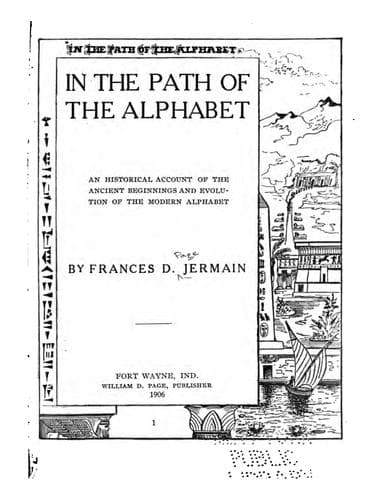
In the path of the alphabet: an historical account of the ancient beginnings and evolution of the modern alphabetJermain, Frances Delavan Page
History
In the path of the alphabet: an historical account of the ancient beginnings and evolution of the modern alphabet
Jermain, Frances Delavan Page
Alphabet
Subjoined are illustrations of cuneiform vowels and consonants as
written:
[Illustration: Cuneiform Vowels and Consonants]
------------------------------------------------------------------------
CHAPTER III.
WHILE yielding to the charm of some master of language, who of us gives
a thought to the fact that the grace and flow, the flexibility, the
mysterious eloquence of written speech is largely due to the invention
of letters. Only twenty-six simple signs, yet what marvels of simplicity
and power! In the readiness of these for new combinations, their varied
adjustments and readjustments in the formation of words, we find the
life and growth, and practically unlimited expansion of language; the
rhythmical melodies of verse; those inherent powers which render them so
adaptive to the wants of man; and withal, so easy to be acquired. Yet
writing without an alphabet is quite possible. In fact, the history of
the past is revealing great nations and people in possession of systems
of writing and of extensive literature, not founded on an alphabet.
We are nevertheless to find that writing without an alphabet is a
difficult and complicated matter. So serious and difficult, that
comparatively few could acquire the art, and that though in great
measure this was confined to special classes, as the scribes who devoted
themselves to the practice, and the priesthood who were invested with
the power, yet the art of writing was understood and in common use to an
extent incomprehensible when the difficulties of its acquirement are
considered. The results were nevertheless to limit the extensions of
knowledge, proving in all directions a barrier to progress.
Truly has it been said that “The history of our alphabet is the golden
thread which entwines itself with the long story of man’s civilization;”
that “It is the greatest triumph of the human mind;” and again, as “The
most wonderful of intellectual achievements.” For we are coming to know
that letters are an invention, not spontaneous productions or miracles
of language, and that evolution, as in other directions of human
inquiry, has much to say upon their origin and history.
Though taking us to a past so remote, the record for the greater part is
singularly distinct and clear. The story is, however, but a recent
revelation, not even as yet fully told, gathering only sufficient
coherence within the past forty years to make the telling intelligible
or possible. A fragment of inscription here, a roll of papyrus there,
illuminated by the inspirations of genius, and the ages which have so
long withheld from us the story of our alphabet, are slowly yielding the
secret.
To give in brief review the leading facts in this story is the simple
purpose of this history.
Public-domain text, read in full here on John Shaqi.
Reviews
Reviews
No reviews yet
Be the first to share your thoughts on this work.
Join the Discussion
Join the discussion
Sign in to leave a comment or review.
Sign InorCreate an account