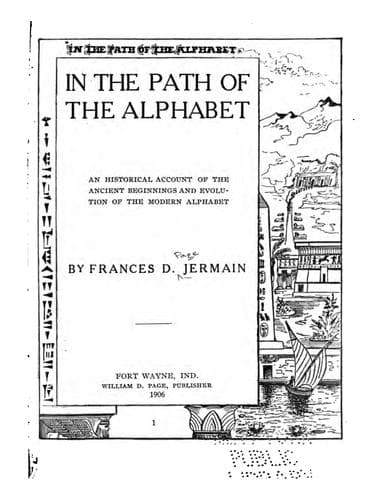
In the path of the alphabet: an historical account of the ancient beginnings and evolution of the modern alphabetJermain, Frances Delavan Page
History
In the path of the alphabet: an historical account of the ancient beginnings and evolution of the modern alphabet
Jermain, Frances Delavan Page
Alphabet
But while in different parts of the world human beings have invented
ways of communicating with the absent without the art of writing, to
depict an object instead of conveying an object, would result as a
simpler and more lasting method of expression.
Thus, in simple pictures of objects, we find the earliest beginnings of
the art of writing. How these may be employed as message bearers or for
the record of events we have abundant illustration in the picture
writings of the North American Indian on the bark of trees, or inscribed
on rocks, metal and stone.
In the same way, in rude carvings with flint chips on bone and ivory,
records of the chase have come down to us from that far off time when
paleolythic man hunted the hairy rhinoceros, the mammoth and the hyena
in the forests of Europe.
Though hardly attaining the art of writing, pictorial representations in
kind were the earliest human attempt in this mode of expression. Later,
when pictures became the symbols of ideas, as the picture of a bee to
symbolize royalty, of an eye to indicate seeing or knowing, two legs to
signify walking or going, or a sparrow for cruelty or inferiority, we
reach a higher stage of progression—relics or reminiscences often of the
old gesture language, or objects sent as symbols of ideas.
These two first stages in the development of the art of writing are
known as ideograms, where signs, symbols or figures suggest the ideas of
objects without expressing their names. To construct a sentence in this
way with the various parts of speech, is impossible.
The next advance was phonetism, the representation of the sound of
words. Thus, the picture of a lion or a camel will be understood
whatever the language of the picture-maker may be. Perhaps, also,
symbols for things, as the sun for light, or an eye for seeing. “But
how,” says Hereen, “can the names of persons, as Henry, Lewis, and the
like, be distinguished by symbolic pictures?”
This is true also of many other words without the adoption of signs or
characters to represent sound, or the names of things, any adequate
expression of facts or ideas is impossible. It thus came about that when
pictures of objects or symbols of ideas obtained a fixed and permanent
sign for the sound in any language phonetism began.
Among the confusions which appear at this stage are the homophones;
relics of that primitive stage in speech, the monosyllabic, when few
sounds were used to express many things. As an example in modern
English, we have such words as pair, pare and pear; or rite, write,
right and wright; words so like in sound, so unlike in meaning.
In our language, these homophones for the greater part are defined by
the variant spelling, but as without an alphabet there could be no
variant spelling, other devices were necessary to indicate the various
meanings of words having the same sound.
Of these ingenious devices, numerous, clever, though cumbrous, yet so
essential before letters appeared, more hereafter.
Public-domain text, read in full here on John Shaqi.
Reviews
Reviews
No reviews yet
Be the first to share your thoughts on this work.
Join the Discussion
Join the discussion
Sign in to leave a comment or review.
Sign InorCreate an account