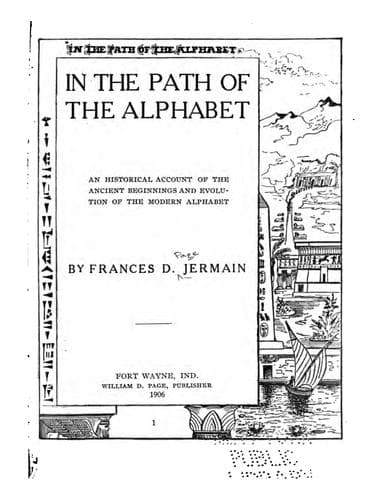
In the path of the alphabet: an historical account of the ancient beginnings and evolution of the modern alphabet — John Shaqi
In the path of the alphabet: an historical account of the ancient beginnings and evolution of the modern alphabetJermain, Frances Delavan Page
History
In the path of the alphabet: an historical account of the ancient beginnings and evolution of the modern alphabet
Jermain, Frances Delavan Page
Alphabet
In the literature of the Chinese there is a work for which they claim
the highest antiquity. Until recently no clew had been found for its
interpretation. This was the “Yih King,” or “Book of Changes,” which has
been a sealed mystery to the ablest Chinese scholars of all ages,
including Confucius. Its interpretation has, however, been accomplished
by M. de Lacouperie who finds this work to be a collection of
syllabaries such as are common in Accadian literature. These are
interspersed with chapters on astronomical and astrological lore. Others
again, refer to the ethnology of primitive inhabitants of the country;
all of these, however, taking the form of vocabularies only possible to
interpret by recognizing their syllabic character.
The appearance of this work in ancient Chinese literature is explained
in two ways. Prof. Douglas regards this as an evidence that in by-gone
ages this language was polysyllabic. He points to the fact that certain
words indicate a former polysyllabism and from this infers that the
language as it now appears is an example of phonetic decay. Others, on
the contrary, see in the occasional but rare evidences of agglutination,
the influence of contact with other races speaking an agglutinative or
polysyllabic tongue, and of which the above example in their ancient
literature is perhaps a literary remains.
It is incredible that a race so advanced in polysyllabism as evidenced
by the “Yih King,” or “Book of Changes,” could revert to so pure a
monosyllabism as is now presented by the Chinese language. Phonetic
decay is possible to many words in a language, but so general a
reversion to primitive conditions is scarcely possible of a whole
language.
Reference has been made in the Chinese system of writing to their use of
picture forms or ideographic signs, in association with the phonograms
to explain the meaning or particular use of these signs.
This principle, so often referred to, is by no means a special invention
of the Chinese, but as we shall see, occurs in all original pictorial
systems of writing with the development of phonetism. This is, that when
phonetic values begin to attach themselves to the primitive ideographs,
these are retained and attached to the signs expressing the primitive
sound.
“As if,” says Prof. Sayce, “to assist the memory in remembering the
meaning and pronunciation of a particular word.”
In this way evidently the “keys” of the Chinese system had their origin,
as also the determinatives of the cuneiform, the hieroglyphic systems of
the Egyptians, the Maya or Mexican, and other pictorial systems.
Among the many advantages obtained from a purely syllabic, or purely
alphabetic system of writing is the easy adjustment of these signs to
various forms of speech. This is eminently true of alphabetic systems.
On the other hand the application of non-alphabetic characters to other
than the original language to which these were adapted is by no means so
simple and manageable in results.
Public-domain text, read in full here on John Shaqi.
Reviews
Reviews
No reviews yet
Be the first to share your thoughts on this work.
Join the Discussion
Join the discussion
Sign in to leave a comment or review.
Sign InorCreate an account