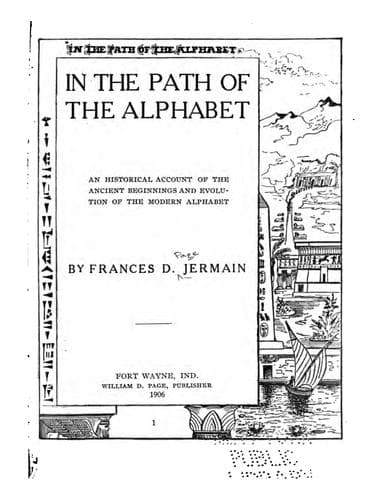
In the path of the alphabet: an historical account of the ancient beginnings and evolution of the modern alphabet — John Shaqi
In the path of the alphabet: an historical account of the ancient beginnings and evolution of the modern alphabetJermain, Frances Delavan Page
History
In the path of the alphabet: an historical account of the ancient beginnings and evolution of the modern alphabet
Jermain, Frances Delavan Page
Alphabet
The heavy rains of the winter season coursing down these declivities for
so many centuries, have in places worn deep ravines in the mounds,
through which the torrents have carried the crumbling debris far out
upon the plain. In this way many valuable relics have come to light;
bits of pottery, inscribed bricks, seals and cylinders, the form and
style of the inscriptions upon some of these indicating great antiquity.
These indications of greater antiquity include inscriptions on bricks
for building purposes as well as those used for record and literature.
They include also the form and character of the inscriptions, whether
archaic or later cuneiform, and again the use of bitumen or cement in
masonry.
In primitive times the first bricks which succeeded the mud wall were
sun-dried and were laid up with reeds and plastered with soft mud or
bitumen. This bitumen was applied hot and adhered so firmly to the
bricks that it is almost impossible to break them apart to obtain the
cement and is one cause why the masonry consisting of sun-dried bricks
has in many cases withstood the ages. Later the sun-dried bricks came to
be used only for interior walls, while for the outer walls bricks were
made from selected clay and were carefully prepared and burned, forming
bricks of superior quality and strength. So well have these withstood
the ravages of time that some of the mounds, notably those of the later
Babylonian period, are veritable quarries of building brick.
It is stated that the bricks of which the temples and palaces of Babylon
were built, have for the past two thousand years supplied cities of the
surrounding region with the material used in the construction of public
and private edifices, and that certain families of the Babili tribe, who
claim to be direct descendants of the Babylonians, are exclusively
employed in quarrying them.
As has been stated, bitumen was used for laying the masonry in the
remoter times long before Babylon was built. Of this substance an
abundant supply was to be obtained at various places in southern
Mesopotamia, near the Arabian desert, notably in the neighborhood of Ur,
now Mugheir, “the bitumened,” so called from the bitumenous springs of
the vicinity. In time, the use of this for masonry gave place to a fine
white mortar made from a peculiar calcareous clay, found near the
Arabian frontier to the west of the Euphrates in southern Mesopotamia,
which for lightness and strength has never been surpassed.
These evidences, including also the inscriptions originally stamped upon
the bricks, with the name of the king or ruler under whose orders they
had been prepared, furnish indications of their time and place in
history.
It thus came about that explorers following the work of Botta, Layard,
George Smith and others, found their way to sites more ancient by many
centuries than the beginnings of Nineveh or Babylon, and have obtained
from these records of great historical importance.
Public-domain text, read in full here on John Shaqi.
Reviews
Reviews
No reviews yet
Be the first to share your thoughts on this work.
Join the Discussion
Join the discussion
Sign in to leave a comment or review.
Sign InorCreate an account