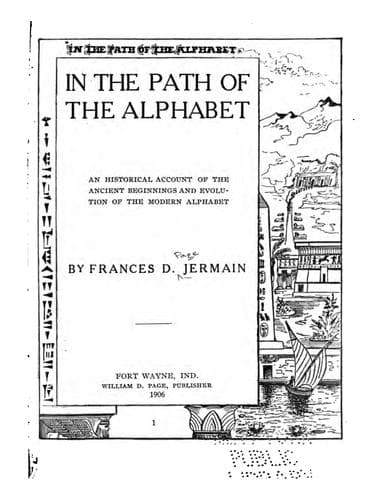
In the path of the alphabet: an historical account of the ancient beginnings and evolution of the modern alphabet — John Shaqi
In the path of the alphabet: an historical account of the ancient beginnings and evolution of the modern alphabetJermain, Frances Delavan Page
History
In the path of the alphabet: an historical account of the ancient beginnings and evolution of the modern alphabet
Jermain, Frances Delavan Page
Alphabet
For further aids to students, vocabularies were compiled, giving the
Accadian word and the Assyrian translation; also, syllabic forms, and it
is by these wonderful literary aids, especially wonderful when we
consider their antiquity, that scholars of to-day are able to read this
ancient Turanian speech as readily as the Semitic Assyrian language of
Sargon’s reign.
The systematic methods adopted in this library are also remarkable.
Doubtless Sargon’s librarians introduced ideas of their own in the
arrangement of this literature, but they had evidently adopted methods
long in use in the more ancient libraries of Erech, Larsa and other
cities of southern Mesopotamia. As instances of this literary
undertaking the great work on astronomy and astrology called “The
Observations of Bel,” which long ages after Berosius translated into
Greek, was by order of Sargon compiled for his library. It consisted of
seventy-two books, and a certain place in the library was set apart for
this. These tablets were arranged and numbered according to the subject.
A catalogue of these was also prepared, giving the number of the tablets
as arranged under the subjects.
Other literary documents from this collection are The Story of Creation,
in prose and verse; The Deluge Story, and Adventures of Izdubar, the
famous Nimrod of Hebrew tradition.
When the student wished for any special tablet or subject, he was
required by the librarian to consult the catalogue and to write down the
number of the book he wished for, when it would be given to him. The
librarian of to-day, to whom the same system and methods are so
familiar, can scarcely claim these as modern improvements, but may well
exclaim with the philosopher of old, “there is no new thing under the
sun.”
Another great work, prepared for the library of Sargon, of Agade, was a
theological collection in three books and two hundred tablets. This
consisted of magical texts and incantations from the primitive religion
of Turanian Chaldea, which still held power and influence as magic and
divination. It included also the literature of the later development of
the Sumerians into higher spiritual conceptions.
This literature of the later period comprised hymns of praise,
invocations to the gods, and penitential psalms which in spirit and form
bear a remarkable resemblance to the confessions of the later Hebrew
psalmist.
Perhaps we may trace in this a contact with Semitic thought and
influence long before the Semites appear as an established people in the
land.
There are two distinct periods in the religious development of the
Turanians of Chaldea, the era of Shamanism or demon worship, and later
Sabeanism, the deification of the planets and the stars or the benign
influence of nature.
Public-domain text, read in full here on John Shaqi.
Reviews
Reviews
No reviews yet
Be the first to share your thoughts on this work.
Join the Discussion
Join the discussion
Sign in to leave a comment or review.
Sign InorCreate an account