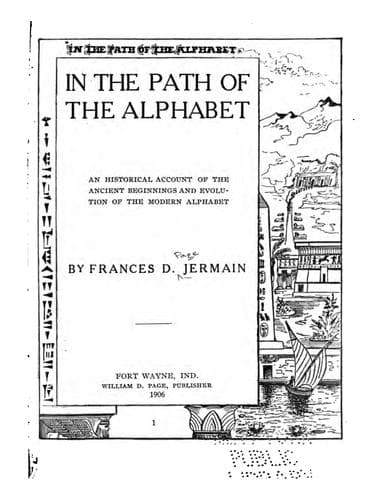
In the path of the alphabet: an historical account of the ancient beginnings and evolution of the modern alphabetJermain, Frances Delavan Page
History
In the path of the alphabet: an historical account of the ancient beginnings and evolution of the modern alphabet
Jermain, Frances Delavan Page
Alphabet
On annalistic tablets of Babylonian kings in the British Museum,
Khammuragas is mentioned and the date accorded to him B. C. 2315, or the
end of his reign B. C. 2259, which gives the date of Urea, The Builder,
as about 2959 B. C.
The most important of the discoveries of Nabonidus, was, however, the
finding of the foundation cylinder of Naram-Sin, the son and successor
of the great Sargon of Accad.
This occurred at the time of his restoration of the Sun temple at
Sippara, near the ancient city of Agane.
Of this, Nabonidus says:
“I brought the Sun God from his temple, and placed him in another
house.”
“I sought for its old foundation stone, and eighteen cubits deep—”
“I dug into the ground and the foundation stone of Naram-Sin, Son of
Sargon, which for thirty-two hundred years no king who had gone
before me had seen.”
“The Sun God—the great Lord of E Bara. Let me see; even me.”
Before the discovery of the cylinder of Nabonidus the date of Sargon of
Accad was uncertain. He had often been regarded as identical with the
later Sargon, the Assyrian king who carried the Ten Tribes of Israel
into captivity about 722 B. C. The numerous records remaining of the
earlier Sargon had made the identity of these two monarchs confusing and
impossible, which was cleared away by the discovery of the records of
Nabonidus.
This king had data for his statements which subsequent discoveries have
confirmed, thus giving to Naram-Sin the date of thirty-two hundred and
fifty years before Nabonidus, which was 550 B. C., and allowing for the
long reign of Sargon I, we have the immense antiquity of B. C. 3800 for
the time of the great Sargon of Accad.
The site where this important discovery was made is one of the two
Sipparas, situated on opposite sides of the royal canal, not far from
the Euphrates, and running parallel with the river.
These two cities were anciently known by their rival sanctuaries, the
one dedicated to the worship of the Sun, and the other to the worship of
the Moon, and were known as the Sippara of the Sun and the Sippara of
Annuit.
The Sippara of Annuit is the supposed site of the ancient Agade of
Sargon. It was, however, at Sippara of the Sun that Naram-Sin, the son
of Sargon, founded the temple which was discovered by Nabonidus and
rediscovered by Mr. Rassam a few years ago.
While making excavations in a mound near the supposed site of Sippara,
Mr. Rassam made his way into some rooms of a vast structure which he
found to be a temple. Passing on from room to room, he at last entered a
smaller chamber which was paved with asphalt. As this kind of pavement
was unusual in Babylonian and Assyrian structures he concluded this must
be the secret depository of records. Having broken into the pavement, he
came finally upon a sealed casket or chest of earthenware, about three
feet below the surface, in which was found a stone tablet, beautifully
inscribed, and also other documents.
Public-domain text, read in full here on John Shaqi.
Reviews
Reviews
No reviews yet
Be the first to share your thoughts on this work.
Join the Discussion
Join the discussion
Sign in to leave a comment or review.
Sign InorCreate an account