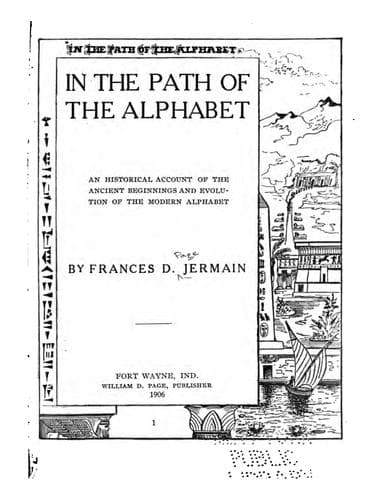
In the path of the alphabet: an historical account of the ancient beginnings and evolution of the modern alphabet — John Shaqi
In the path of the alphabet: an historical account of the ancient beginnings and evolution of the modern alphabetJermain, Frances Delavan Page
History
In the path of the alphabet: an historical account of the ancient beginnings and evolution of the modern alphabet
Jermain, Frances Delavan Page
Alphabet
“To Naram-Sin, King of the Four Races, Conqueror of Apirak and Magan.”
A second alabaster vase was found by M. de Sarazec in the ruins of
Tel-Loh, having inscribed on it the words:
“Naram-Sin, King of the Four Regions,” or king of the north, south, east
and west.
This vase was imbedded in the masonry, evidently later restorations of
the earlier buildings of Gudea.
A cylinder found by General Cesnola, at Cyprus has on it an inscription
declaring its owner as a worshipper of Naram-Sin, who it seems had been
deified by his subjects.
In the first volume of Babylonian inscriptions found at Nippur, Prof.
Hilfrecht records six inscriptions of Sargon, two brick stamps of baked
clay, fragments of many vases and three door sockets, most of these
temple offerings to Bel—Mul-lil, of Nippur. The door sockets contain the
longest inscriptions of Sargon thus far known.
There are many inscriptions of Naram-Sin in the Nippur remains, and yet
more now in course of translation. These refer again to the restoration
by these kings of the temple of Bel and their dominion over the whole of
South Babylonia.
As these explorations are yet in progress, it is too early to indicate
the farther evidences of these early rulers of Babylonia remaining at
Nippur.
The various localities in which these relics have been found indicate
the extensive sway of these monarchs. They suggest also the period when
certain gods of Chaldea were adopted by the various nations and people
conquered by Sargon or Naram-Sin.
Sinai, the mountain of Sin, the Moon God, may be a reminiscence of the
invasion of Arabia by Naram-Sin directed by this divinity.
Mount Nebo, the mountain upon which Moses died, received its name from
the Chaldean Nebo, the god of science and literature, the god of wisdom
and prophesy.
Istar, the evening star, the Chaldean Venus, the goddess of love and
fertility, became the Atthar of southern Arabia, is identical with the
goddess Hathor, of Egyptian mythology, and was worshipped by the
Canaanites as Ashtaroth, and finally by the Greeks as Astarte.
Against this background of history and tradition, of civilization so
remote, a notable figure appears about fifteen hundred and forty years
later than the great Sharrukin, or 2260 B. C., in whom the most sacred
traditions of later civilizations were to have their rise.
This was Abraham, or Abu-ramu, “the exalted father” with whom the
history of the people of Israel begins. A Semite, and a native of Ur,
his historical position is an important landmark in the story of
letters.
Of special significance in this connection is this early contact of
Abraham and his family with the land and people of Chaldea;—the
lingering survivals of Accadian speech and traditions in Hebrew language
and literature.
Again, when Abraham left Chaldea to found a great nation in another
land, writing and literature could not have been unknown to him.
Public-domain text, read in full here on John Shaqi.
Reviews
Reviews
No reviews yet
Be the first to share your thoughts on this work.
Join the Discussion
Join the discussion
Sign in to leave a comment or review.
Sign InorCreate an account