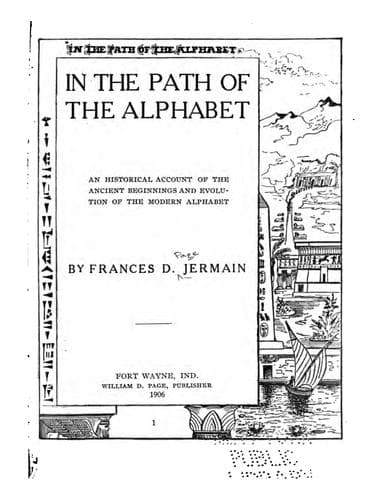
In the path of the alphabet: an historical account of the ancient beginnings and evolution of the modern alphabetJermain, Frances Delavan Page
History
In the path of the alphabet: an historical account of the ancient beginnings and evolution of the modern alphabet
Jermain, Frances Delavan Page
Alphabet
The greater simplicity of the Persian versions in the trilingual
inscriptions, suggested less difficulties to overcome and led him to
pursue the same lines by which Grotefend had previously obtained
success.
Sir Henry Rawlinson was able to carry forward the decipherment of
cuneiform much farther than Grotefend, owing partly to the better
knowledge of the ancient languages of Persia attained at this time, and
partly to the fact that he had escaped the mistakes which obstructed
Grotefend in his later decipherments of cuneiform.
It will be remembered that Grotefend discovered the true values of
twelve of the forty-eight letters of the Persian alphabet. Further than
this he did not go. He made the mistake of supposing all the vowel
sounds were expressed in this system, which is not the case.
With some of the consonants, the vowel sound is inherent and is not
written with an independent sign. This mistake prevented his further
progress; but his success had pointed the way, and a host of eager and
able scholars at once entered this new field of oriental philology.
The most promising direction seemed to be the Zend, the so called
language in which the sacred books of the Parsees was written. Of this,
but one or two fragments known to be genuine were at this time to be
found in the libraries of Europe; one in the Bodleian Library, chained
to the wall, and here and there a few stray leaves of Zend manuscript in
other collections.
In the year 1771 a work had been deposited by its author, Anquetil
Duperron, which he claimed to be a translation from the original
Zend-Avesta, with copy of the texts.
The work had been pronounced a forgery by certain distinguished
scholars; but the well known scholarship of its author held the
judgments of other learned philologists in abeyance.
The story of this effort is of romantic interest. While a youth,
preparing for priesthood in the seminaries of Paris, he became so
absorbed in the study of language, that he gave himself entirely to
these pursuits, abandoning his intentions of the study of theology.
While thus engaged, some stray leaves of a Zend manuscript came into his
hands, which so filled his mind with a desire to read the language of
the Parsees that he determined to do so.
At this time the conflicting interests of the English and French in
India reached a crisis. Enlisting as a private soldier in the French
army, he was about to sail for India when the officers of the institute
to which he was attached, affected by his zeal for learning, obtained
from the Minister of War a free passage for him to Pondicherry, with a
seat during the voyage at the captain’s table and a salary to be paid
him on his arrival in India while he carried on his studies.
After reaching Pondicherry, he began the study of Sanscrit and Arabic,
and later on, through great hardship, finally reached Surat.
Public-domain text, read in full here on John Shaqi.
Reviews
Reviews
No reviews yet
Be the first to share your thoughts on this work.
Elsewhere in the archive
Join the Discussion
Join the discussion
Sign in to leave a comment or review.
Sign InorCreate an account