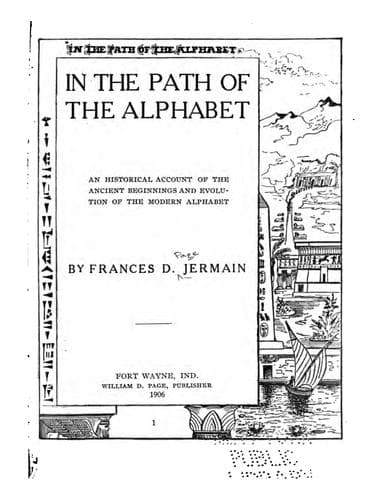
In the path of the alphabet: an historical account of the ancient beginnings and evolution of the modern alphabetJermain, Frances Delavan Page
History
In the path of the alphabet: an historical account of the ancient beginnings and evolution of the modern alphabet
Jermain, Frances Delavan Page
Alphabet
Here he obtained the confidence of certain Parsee priests, who permitted
him access to their sacred books, and through whose assistance he
acquired sufficient knowledge of the language in which they were
written, to enable him to translate the Zend-Avesta.
Returning to Paris in 1762, with over a hundred precious manuscripts, he
obtained a small post in the royal library, where he spent the next nine
years in the preparation of his copies of the original texts of the
Zend-Avesta, translating these for publication. In 1771 the work was
completed and he had the satisfaction of placing in the Royal Library of
Paris the first authentic version of the Zend-Avesta and the first
translation that had ever appeared in any European language. As before
stated, many scholars of the time were not prepared for the work,
denying its authenticity and proclaiming it an audacious forgery.
Under this cloud, the intrepid author of this work, conscious of the
importance of his contribution to learning, undaunted by the fate which
so long delayed the just recognition of his labors, passed the remainder
of his days in cheerful resignation.
He lived to congratulate Grotefend upon his achievements in the
decipherment of cuneiform and died shortly after, in 1808, at the
advanced age of seventy-seven.
Twenty years later, the honors due his name came through the researches
of the illustrious scholars, Rask and Burnouf, who proved this great
work of Anquetil Duperron to be a genuine if not correct translation of
the Zend-Avesta, as obtained through the sacred books of the Parsees.
It was by a study of this translation that the key to the ancient
Persian language was obtained and has since served an important use in
the study of Zend[5] philology.
Notwithstanding its value, this translation of the Zend-Avesta was by no
means perfect. The faulty teachings of the Parsee priests led the author
into occasional errors which obstructed the progress of later scholars
who depended too closely upon it for results. Little by little, however,
from the work of Sir Henry Rawlinson on the Behistun inscriptions, thro’
the researches of Burnouf in the original Zend manuscripts; again from
testimony furnished by other distinguished scholars, from coins and
other inscriptions, and still again by a comparative study of Sanscrit,
modern Persian and Arabic, all the letters of the old Persian cuneiform
have been obtained, until now it is as easily and distinctly read as
Greek or Hebrew.
It is impossible, within these limits, to follow the steps by which
these important results were obtained. The methods employed in such
researches are often only intelligible to philologists themselves.
In this special study, the epigraphic materials examined included not
only cuneiform signs, but characters representing the fully developed
alphabets of later periods, alphabets which had superseded the cuneiform
as systems of writing, though expressing the ancient speech of Persia.
Public-domain text, read in full here on John Shaqi.
Reviews
Reviews
No reviews yet
Be the first to share your thoughts on this work.
Elsewhere in the archive
Join the Discussion
Join the discussion
Sign in to leave a comment or review.
Sign InorCreate an account