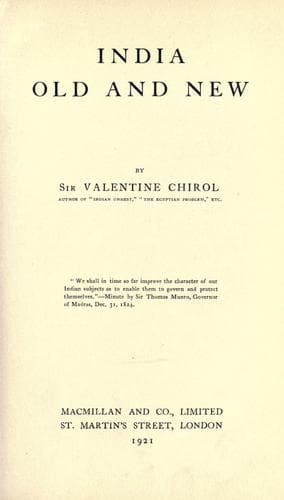
One of the first questions to come before the new Parliament elected
after the great Reform Bill was that of the renewal of the Company's
charter in 1833. The Parliamentary Committee appointed to inquire and
report on the subject struck a new note when it laid distinct stress on
the Indian point of view. It admitted frankly that "Indians were alive
to the grievance of being excluded from a larger share in the executive
government," and proceeded to state that in its opinion ample evidence
had been given to show "that such exclusion is not warranted on the
score of their own incapacity for business or the want of application or
trustworthiness." Accordingly, when the Charter was renewed, Parliament
laid it down that "no native of the said Indian territories, nor any
natural British-born subject of His Majesty resident therein, shall by
reason only of his religion, place of birth, descent, colour, or any of
them be disabled from holding any place, office, or employment under the
Company." This was the first substantial promise given to India that
British rule was not to spell merely the unqualified dominion, however
beneficent, of alien rulers. It invited the co-operation of the subject
race, instead of merely postulating unconditional submission. It
heralded at the same time the introduction of Western education, without
which the promise would have been empty.
The problem of Indian education had occupied the minds of far-sighted
Englishmen from the days of Warren Hastings, who had been the first to
provide out of the Company's funds for the maintenance of indigenous
educational institutions, and it had been definitely provided in the
renewal of the Charter in 1813 that the Company should set aside a
certain portion of its revenues to be spent annually upon education. But
long delays had been caused by an interminable and fierce controversy
over the rival merits of the vernaculars and of English as the more
suitable vehicle for the diffusion of education. The champions of
English were much encouraged by the immediate success which attended the
opening of an English school in Calcutta in 1830 by Dr. Alexander Duff,
a great missionary who was convinced that English education could alone
win over India to Christianity, and Macaulay's famous Minute of March 7,
1835, disfigured as it is by the quite unmerited and ignorant scorn
which he poured out on Oriental learning with his customary
self-confidence, finally turned the scales in favour of the adoption of
English as essential to the spread of Western education. One of the
immediate objects in view--and incidentally as a measure of economy--was
undoubtedly the training of Indians, and in much larger numbers, for the
more efficient performance of the work allotted to them in the
administrative and judicial services of the Company. But if Macaulay was
quite wrong in imagining that Western education would assimilate Indians
to Englishmen in everything but their complexions, he was by no means
Public-domain text, read in full here on John Shaqi.
Reviews
Reviews
No reviews yet
Be the first to share your thoughts on this work.
Elsewhere in the archive
Join the Discussion
Join the discussion
Sign in to leave a comment or review.
Sign InorCreate an account