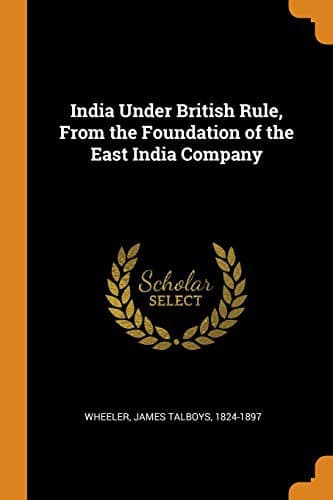
India Under British Rule from the Foundation of the East India CompanyWheeler, James Talboys
History
India Under British Rule from the Foundation of the East India Company
Wheeler, James Talboys
India -- History -- British occupation, 1765-1947
From 1806 to 1810 the Rajas of Jeypore and Jodhpore were fighting for
the hand of this daughter of the Rana. The girl herself had no voice in
the matter. In Rajput traditions a princess is supposed to choose her
own bridegroom in an assembly of Rajas, by throwing a garland round the
neck of the happy lover. But in modern practice the "choice" has fallen
into disuse, and a gilded cocoa-nut is sent by the father of the
princess to some selected Raja as typical of an offer of her hand. The
cocoa-nut for the Oodeypore princess had been sent to a Raja of
Jodhpore, but he died before the marriage, and the cocoa-nut was sent to
the Raja of Jeypore. Then followed a contention. The new Raja of
Jodhpore claimed the princess, on the ground that the offer had been
made, not to the individual, but to the throne of Jodhpore. The Raja of
Jeypore, however, had accepted the cocoa-nut, and insisted on his
rights. The contention became a war to the knife, and nearly every
prince in Rajputana took a part in the contest. Strange to say, the Rana
himself, the father of the princess, looked on as a neutral whilst
Jeypore and Jodhpore were fighting for his daughter. Meanwhile his
territories, known as the garden of Rajputana, were ravaged by Sindia
and an Afghan adventurer named Amir Khan, until nothing was to be seen
but ruined harvests and desolated villages.
[Sidenote: Non-intervention.]
Amidst this terrible turmoil, the princes and chiefs of Rajputana
implored the British government to interfere. They asserted that there
always had been a paramount power in India; that such a power had been
formerly exercised by the Great Mogul; that the East India Company had
acquired that power; and that the British government was bound to stop
the war. The Rana of Oodeypore offered to cede half his territories if
the British government would protect the other half. Jeypore and
Jodhpore offered to submit their claims to British arbitration, and
pledged themselves to abide by the decision. Lord Minto had only to
declare which bridegroom he recognised, and his dictum would have been
accepted. But Lord Minto shrunk from the exercise of a sovereignty which
would have been a violation of the sacred dogma of non-interference, and
have carried British influence outside British territories. Accordingly,
the war was stopped by a tragedy. The Rana settled the marriage dispute
by poisoning his daughter. The young princess is said to have drunk the
fatal draught with the courage of a heroine, knowing that it would save
her father; but the unhappy mother was overpowered by grief, and died
broken-hearted.
[Sidenote: Ghorka conquest of Nipal.]
Public-domain text, read in full here on John Shaqi.
Reviews
Reviews
No reviews yet
Be the first to share your thoughts on this work.
Elsewhere in the archive
Join the Discussion
Join the discussion
Sign in to leave a comment or review.
Sign InorCreate an account