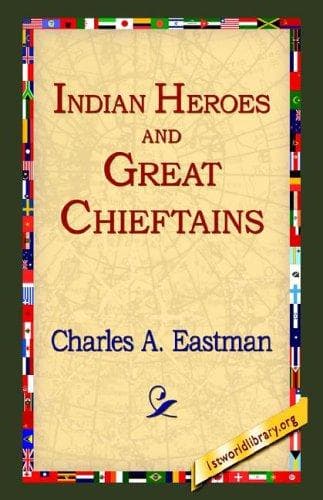
Indian Heroes and Great ChieftainsEastman, Charles A.
History
Indian Heroes and Great Chieftains
Eastman, Charles A.
Dakota Indians -- Biography; Heroes; Indians of North America -- Biography
He left Canada with a few trusted friends, including his youngest and
favorite son. When within two or three days’ journey of St. Paul, he
told the others to return, keeping with him only his son, Wowinape, who
was but fifteen years of age. He meant to steal into the city by night
and go straight to Governor Ramsey, who was his personal friend. He was
very hungry and was obliged to keep to the shelter of the deep woods.
The next morning, as he was picking and eating wild raspberries, he was
seen by a wood-chopper named Lamson. The man did not know who he was.
He only knew that he was an Indian, and that was enough for him, so he
lifted his rifle to his shoulder and fired, then ran at his best pace.
The brilliant but misguided chief, who had made that part of the country
unsafe for any white man to live in, sank to the ground and died without
a struggle. The boy took his father’s gun and made some effort to find
the assassin, but as he did not even know in which direction to look for
him, he soon gave up the attempt and went back to his friends.
Meanwhile Lamson reached home breathless and made his report. The body
of the chief was found and identified, in part by the twice broken arm,
and this arm and his scalp may be seen to-day in the collection of the
Minnesota Historical Society.
TAMAHAY
There was once a Sioux brave who declared that he would die young, yet
not by his own hand. Tamahay was of heroic proportions, herculean in
strength, a superb runner; in fact, he had all the physical qualities of
an athlete or a typical Indian. In his scanty dress, he was beautiful as
an antique statue in living bronze. When a mere youth, seventeen years
of age, he met with an accident which determined his career. It was
the loss of an eye, a fatal injury to the sensitive and high-spirited
Indian. He announced his purpose in these words:
“The ‘Great Mystery’ has decreed that I must be disgraced. There will be
no pleasure for me now, and I shall be ridiculed even by my enemies. It
will be well for me to enter soon into Paradise, for I shall be happy
in spending my youth there. But I will sell my life dearly. Hereafter
my name shall be spoken in the traditions of our race.” With this speech
Tamahay began his career.
He now sought glory and defied danger with even more than the ordinary
Indian recklessness. He accepted a personal friend, which was a custom
among the Sioux, where each man chose a companion for life and death.
The tie was stronger than one of blood relationship, a friendship sealed
by solemn vow and covenant. Tamahay’s intimate was fortunately almost
his equal in physical powers, and the pair became the terror of
neighboring tribes, with whom the Dakotas were continually at war. They
made frequent raids upon their enemies and were usually successful,
although not without thrilling experiences and almost miraculous
escapes.
Public-domain text, read in full here on John Shaqi.
Reviews
Reviews
No reviews yet
Be the first to share your thoughts on this work.
Join the Discussion
Join the discussion
Sign in to leave a comment or review.
Sign InorCreate an account