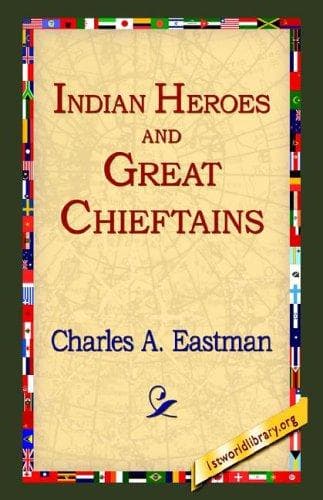
Indian Heroes and Great ChieftainsEastman, Charles A.
History
Indian Heroes and Great Chieftains
Eastman, Charles A.
Dakota Indians -- Biography; Heroes; Indians of North America -- Biography
Gall had an amiable disposition but was quick to resent insult or
injustice. This sometimes involved him in difficulties, but he seldom
fought without good cause and was popular with his associates. One of
his characteristics was his ability to organize, and this was a large
factor in his leadership when he became a man. He was tried in many
ways, and never was known to hesitate when it was a question of physical
courage and endurance. He entered the public service early in life, but
not until he had proved himself competent and passed all tests.
When a mere boy, he was once scouting for game in midwinter, far from
camp, and was overtaken by a three days’ blizzard. He was forced to
abandon his horse and lie under the snow for that length of time.
He afterward said he was not particularly hungry; it was thirst and
stiffness from which he suffered most. One reason the Indian so loved
his horse or dog was that at such times the animal would stay by him
like a brother. On this occasion Gall’s pony was not more than a stone’s
throw away when the storm subsided and the sun shone. There was a
herd of buffalo in plain sight, and the young hunter was not long in
procuring a meal.
This chief’s contemporaries still recall his wrestling match with the
equally powerful Cheyenne boy, Roman Nose, who afterward became a chief
well known to American history. It was a custom of the northwestern
Indians, when two friendly tribes camped together, to establish the
physical and athletic supremacy of the youth of the respective camps.
The “Che-hoo-hoo” is a wrestling game in which there may be any number
on a side, but the numbers are equal. All the boys of each camp are
called together by a leader chosen for the purpose and draw themselves
up in line of battle; then each at a given signal attacks his opponent.
In this memorable contest, Matohinshda, or Gall, was placed opposite
Roman Nose. The whole people turned out as spectators of the struggle,
and the battlefield was a plateau between the two camps, in the midst
of picturesque Bad Lands. There were many athletic youths present, but
these two were really the Apollos of the two tribes.
In this kind of sport it is not allowed to strike with the hand, nor
catch around the neck, nor kick, nor pull by the hair. One may break
away and run a few yards to get a fresh start, or clinch, or catch as
catch can. When a boy is thrown and held to the ground, he is counted
out. If a boy has met his superior, he may drop to the ground to escape
rough handling, but it is very seldom one gives up without a full trial
of strength.
Public-domain text, read in full here on John Shaqi.
Reviews
Reviews
No reviews yet
Be the first to share your thoughts on this work.
Join the Discussion
Join the discussion
Sign in to leave a comment or review.
Sign InorCreate an account