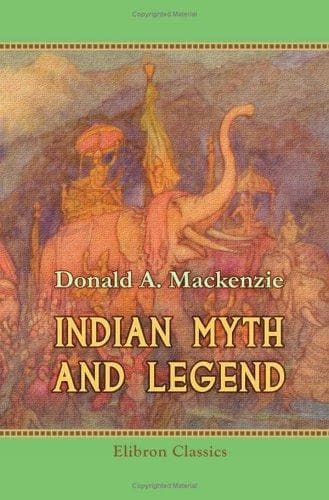
Indian Myth and LegendMackenzie, Donald A. (Donald Alexander)
History
Indian Myth and Legend
Mackenzie, Donald A. (Donald Alexander)
Hindu mythology; Legends -- India
The _Mahabharata_, which deals with the Great War for ascendancy
between two families descended from King Bharata, has been aptly
referred to as “the Iliad of India”. It appears to have evolved from
a cycle of popular hero songs, but after assuming epic form it was
utilized by the Brahmans for purposes of religious propaganda. The
warriors were represented as sons of gods or allies of demons, and the
action of the original narrative was greatly hampered by inserting
long speeches and discussions regarding Brahmanic conceptions and
beliefs. An excellent example of this process is afforded by the famous
_Bhagavad-gita_, from which we have quoted in the previous chapter. The
narrative of the first day's battle is interrupted to allow Krishna to
expound the doctrines of the Vaishnava faith, with purpose to make
converts to the cult of Vishnu. Almost every incident in the poem is
utilized in a similar manner. In fact the epic, as we are informed in
the opening section, “furnisheth the means of arriving at the knowledge
of Brahma”. The priests, with this aim in view, loaded the chariots of
heroes with religious treatises, and transformed a tribal struggle for
supremacy into a great holy war. If the _Iliad_ survived to us only in
Pope's translation, and our theologians had scattered through it, say,
metrical renderings of Bunyan's _Pilgrim's Progress_, the Thirty-nine
Articles of the Church of England, the _Westminster Confession of
Faith_, Fox's _Book of Martyrs_, and a few representative theological
works of rival sects, a fate similar to that which has befallen the
_Mahabharata_ would now overshadow the great Homeric masterpiece. The
“Iliad of India” is a part of what may be called the Hindu Bible, which
embraces the _Ramayana_, the _Vedas_, the _Upanishads_, the _Puranas_,
&c.
The _Ramáyana_, which is called “the Odyssey of India”, because it
deals with the wanderings and adventures of the exiled prince Rama, was
utilized mainly by the cult of Vishnu, but both Vishnu and Shiva figure
as great gods in the _Mahábhárata_, and now one and anon the other is
given first place.
If the documentary material, which is available in India for dealing
with its ancient religious beliefs, were as scanty as those which
survive to us from Ancient Egypt, comparisons might have been drawn
between the Brahmanic cults and the priestly theorists of Heliopolis,
Memphis, Sais, &c., and it might have been remarked of the one nation
as of the other that its people clung to archaic beliefs long after
new and higher religious conceptions obtained as tenets of orthodox
religion. In India the process of change and development can, however,
be not only traced, but partially accounted for, as we have shown. Old
myths were embraced in the epics and the _Puranas_ for the purpose of
educating the people by effecting a compromise between folk religion
and the profound doctrines of the ancient forest sages.
Public-domain text, read in full here on John Shaqi.
Reviews
Reviews
No reviews yet
Be the first to share your thoughts on this work.
Elsewhere in the archive
Join the Discussion
Join the discussion
Sign in to leave a comment or review.
Sign InorCreate an account