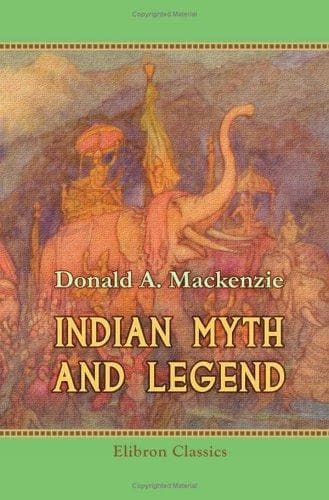
Indian Myth and LegendMackenzie, Donald A. (Donald Alexander)
History
Indian Myth and Legend
Mackenzie, Donald A. (Donald Alexander)
Hindu mythology; Legends -- India
These 12,000 divine years equal 4,320,000 years of mortals, each
human year being composed of 360 days. A thousand of these periods of
4,320,000 years equals one day (Kalpa) of Brahma. During “the day of
Brahma” fourteen Manus reign: each Manu period is a Manvantara. A year
of Brahma is composed of 360 Kalpas, and he endures for 100 of these
years. One half of Brahma's existence has now expired.
At the end of each “day” (Kalpa) Brahma sleeps for a night of equal
length, and before falling asleep the Universe becomes water as at the
beginning. He creates anew when he wakes on the morning of the next
Kalpa.[151]
[151] Abridged from Muir's _Original Sanskrit Texts_, pp. 43, 44, and
Wilson's _Manu_, p. 50.
One of the most interesting accounts of the Yugas is given in the
_Mahábhárata_. It is embedded in a narrative which reflects a phase of
the character of that great epic.
Bhima of the Pan´davas, the human son of the wind god Vayu, once went
forth to obtain for his beloved queen the flowers of Paradise—those
Celestial lotuses of a thousand petals with sun-like splendour and
unearthly fragrance, which prolong life and renew beauty: they grow
in the demon-guarded woodland lake in the region of Kuvera, god of
treasure. Bhima hastened towards the north-east, facing the wind, armed
with a golden bow and snake-like arrows; like an angry lion he went,
nor ever felt weary. Having climbed a great mountain he entered a
forest which is the haunt of demons, and he saw stately and beautiful
trees, blossoming creepers, flowers of various hues, and birds with
gorgeous plumage. A soft wind blew in his face; it was anointed with
the perfume of Celestial lotus; it was as refreshing as the touch of
a father's hand. Beautiful was that sacred retreat. The great clouds
spread out like wings and the mountain seemed to dance; shining streams
adorned it like to a necklace of pearls.
Bhima went speedily through the forest; stags, with grass in their
mouths, looked up at him unafraid; invisible Yakshas and Gandharvas
watched him as he went on swifter than the wind, and ever wondering how
he could obtain the flowers of Paradise without delay....
At length he hastened like to a hurricane, making the earth tremble
under his feet, and lions and tigers and elephants and bears arose and
took flight from before him. Terrible was then the roaring of Bhima.
Birds fluttered terror-stricken and flew away; in confusion arose the
geese and the ducks and the herons and the kokilas....[152] Bhima tore
down branches; he struck trees and overthrew them; he smote and slew
elephants and lions and tigers that crossed his path. He blew on his
war-shell and the heavens trembled; the forest was stricken with fear;
mountain caves echoed the clamour; elephants trumpeted in terror and
lions howled dismally.
[152] Indian cuckoo.
Public-domain text, read in full here on John Shaqi.
Reviews
Reviews
No reviews yet
Be the first to share your thoughts on this work.
Elsewhere in the archive
Join the Discussion
Join the discussion
Sign in to leave a comment or review.
Sign InorCreate an account