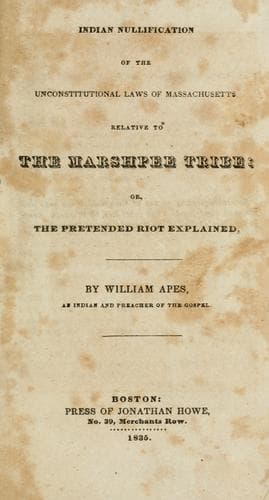
Indian Nullification of the Unconstitutional Laws of Massachusetts Relative to the Marshpee Tribe: Or, the Pretended Riot ExplainedApess, William
History
Indian Nullification of the Unconstitutional Laws of Massachusetts Relative to the Marshpee Tribe: Or, the Pretended Riot Explained
Apess, William
Indians of North America -- Legal status, laws, etc.; Mashpee Indians -- Land tenure; Mashpee Indians -- Legal status, laws, etc.
Some people may say that William Apes wants to get what Mr. Fish
has, but all he asks is, that Harvard College and the State will not
support an _established religion_ in Marshpee, but leave the Indians
free to choose for themselves. Mr. Williams did not give his property
to the Marshpee Indians, more than to any others. It was designed for
all the Indians in New England, and we cannot see what right Harvard
College has to give it all for the whites near Marshpee and the
Indians on Martha's Vineyard. If they are afraid that blind Joseph or
William Apes, the Indian preachers, should have any of this money, if
it is withdrawn from Mr. Fish, let them take it, and send a missionary
among the Marshpee Indians they like. Or let them employ a man, some
Elliot, if they can find one, to visit all the Indians in New England,
to find out their condition and spiritual wants, and try to relieve
them. This would be doing some good with money that is now only used
to disturb the Indians, to take from them their Meeting-house, to
create divisions among them, and turn what the pious Williams meant
for a blessing into a curse to the Indians. What would the pious
Williams say to Harvard College, could he visit Marshpee on a Sabbath?
He might go to the Meeting-House built for the Indians, by the society
in England, of which I believe he was a principal member. He would
find a while man in the pulpit, white singers loading the worship, and
the body of the church occupied by seventy or a hundred white persons,
of the neighboring villages, scarcely one of whom lives on the
plantation. Among these he would see four, five, six, or possibly ten
persons with colored skins; not but one male among them, belonging to
the church. He would probably think he had made a mistake, and that
he was in a white town, and not among the Indians. He might then go to
the house of blind Joseph, (the colored Baptist preacher,) or to the
School-house in Marshpee, and he would there find twenty, thirty, or
forty Indians, all engaged in the solemn worship of God, united and
happy, with a little church, growing in grace. He might then visit the
other School-house, at the neck, where he would find William Apes,
an Indian, preaching to fifty, sixty, or seventy, and sometimes an
hundred Indians, all uniting in fervent devotion. After the sermon, he
would hear a word of exhortation from several of the colored brethren
and sisters, in their broken way, but which often touches the heart
of the Indian, more than all the learning that Harvard College can
bestow. He would hear the Indians singing praises to God, and making
melody in their hearts if not in their voices. What would he say then,
when told that Harvard College had paid twelve thousand dollars of his
funds for converting the poor Indians, to the white minister, who
had made twenty members in twenty-four years, while the two Indian
preachers, with forty-seven members to their churches, added in
three years, were like St.
Public-domain text, read in full here on John Shaqi.
Reviews
Reviews
No reviews yet
Be the first to share your thoughts on this work.
Elsewhere in the archive
Join the Discussion
Join the discussion
Sign in to leave a comment or review.
Sign InorCreate an account