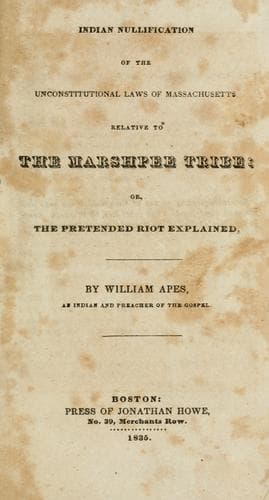
Indian Nullification of the Unconstitutional Laws of Massachusetts Relative to the Marshpee Tribe: Or, the Pretended Riot ExplainedApess, William
History
Indian Nullification of the Unconstitutional Laws of Massachusetts Relative to the Marshpee Tribe: Or, the Pretended Riot Explained
Apess, William
Indians of North America -- Legal status, laws, etc.; Mashpee Indians -- Land tenure; Mashpee Indians -- Legal status, laws, etc.
In 1763, Marshpee was incorporated as a District, including the land
now called the parsonage. "_Be it enacted_, &c. that all the lands
_belonging_ to the Indians and mulattos in Mashpee be erected into a
district, by the name of Mashpee." The Proprietors are empowered to
meet "IN THE PUBLIC MEETING HOUSE," [the one now claimed by Mr. Fish,]
to elect a Moderator, five Overseers, two to be Englishmen, a town
Clerk and Treasurer, being Englishmen, two Wardens, and one or more
Constables. The majority of the Overseers had the sole power to
regulate the fishery, to lease such lands and fisheries as are held in
common, not exceeding for two years, and to allot to the Indians their
upland and meadows. This act was to continue for three years and
no longer. It does not appear ever to have been revived. The
revolutionary war intervened, and there is no act after 1766, until
the act of 1788, after the revolutionary war, which last act put the
Indians and their lands under strict guardianship.
In this interval between 1766 and 1788, the only transaction on which
Mr. Fish can found any claim to the parsonage look place. There
was then either no law existing, which could empower any person to
sequester and set apart the lands of the Indians, or the law of 1693,
(if that of 1763 had expired,) was revived, by which the guardianship
again attached to the Indians. The Indians, it is believed, continued
to choose their own Overseers, under the charter of 1763, after it
had expired, and without any authority to do so. It was the only
government they had during the troubles of the revolution.
We now come to the first evidence of any thing relating to the
parsonage land being set apart from the common land. This was in 1783,
and the following is the Deed from the Records of Barnstable County,
and the only deed relating to this property.
DEED OF MARSHPEE PARSONAGE.
Public-domain text, read in full here on John Shaqi.
Reviews
Reviews
No reviews yet
Be the first to share your thoughts on this work.
Elsewhere in the archive
Join the Discussion
Join the discussion
Sign in to leave a comment or review.
Sign InorCreate an account