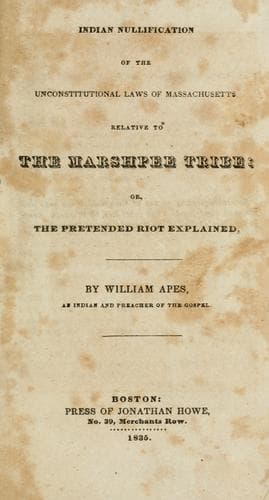
Indian Nullification of the Unconstitutional Laws of Massachusetts Relative to the Marshpee Tribe: Or, the Pretended Riot ExplainedApess, William
History
Indian Nullification of the Unconstitutional Laws of Massachusetts Relative to the Marshpee Tribe: Or, the Pretended Riot Explained
Apess, William
Indians of North America -- Legal status, laws, etc.; Mashpee Indians -- Land tenure; Mashpee Indians -- Legal status, laws, etc.
The first act of the General Court which interfered with the right of
the Indians to sell their own lands, all of which they owned in common
in Marshpee Plantation, (including what is now called the parsonage,)
was in 1650, which provides that no person shall _buy_ land of
any Indian without license of the General Court. In 1665, this was
extended to grants for term of years. In 1693, the Indians were put
under guardianship.
In 1701, an Act was passed specially to protect the Indians in the
enjoyment of their lands. [Col. Laws, page 150,] It also shows why the
restriction in the sale of their lands was adopted.
"Whereas, the government of the late Colonies of the
Massachusetts Bay and New Plymouth, to the intent the native
Indians might not be injured or defeated of their just rights
and possessions, or be imposed on and abused in selling and
disposing of their lands, and thereby deprive themselves
of such places as were suitable for their settlement", did
inhibit the purchase of land without consent of the General
Court, notwithstanding which, sundry persons have made
purchases, &c.; therefore, all such purchases of lands were
vacated, with the exception of towns, or persons who had
obtained lands from the Indians, and also by virtue of a grant
or title made or derived by or from the General Court. All
leases of land from Indians for any term or terms of years to
be void, unless license was obtained for such lease from
the County Court of Sessions. _Provided_, nevertheless, that
nothing in this act shall be held or deemed in any wise to
hinder, defeat or make void any bargain, sale or lease of
land, made by an Indian to another Indian or Indians.
1718. This is the first act which took from the Indians
their civil capacity to make contracts. It says, "whereas,
notwithstanding the care taken and provided (by the former
act,) a great wrong and injury happens to said Indians,
natives of this country, by reason of their being drawn in by
small gifts, or small debts, when they are in drink, and out
of capacity to trade, to sign unreasonable bills or bonds for
debts which are soon sued, and great charge brought upon them,
when they have no way to pay the same, but by servitude";
therefore no contract whatever shall be recovered against any
Indian native, unless entered into before two Justices of the
Peace in the County, both to be present when the contract is
executed by the Indian.
The act of 1725, recognizes the rights of Indians to employ persons
to build houses on _their own lands_. Their own lands then were the
commons, including the parsonage.
Public-domain text, read in full here on John Shaqi.
Reviews
Reviews
No reviews yet
Be the first to share your thoughts on this work.
Elsewhere in the archive
Join the Discussion
Join the discussion
Sign in to leave a comment or review.
Sign InorCreate an account